Justice Joseph Grodin Remembered for Shaping Law and Inspiring UC Law SF Students
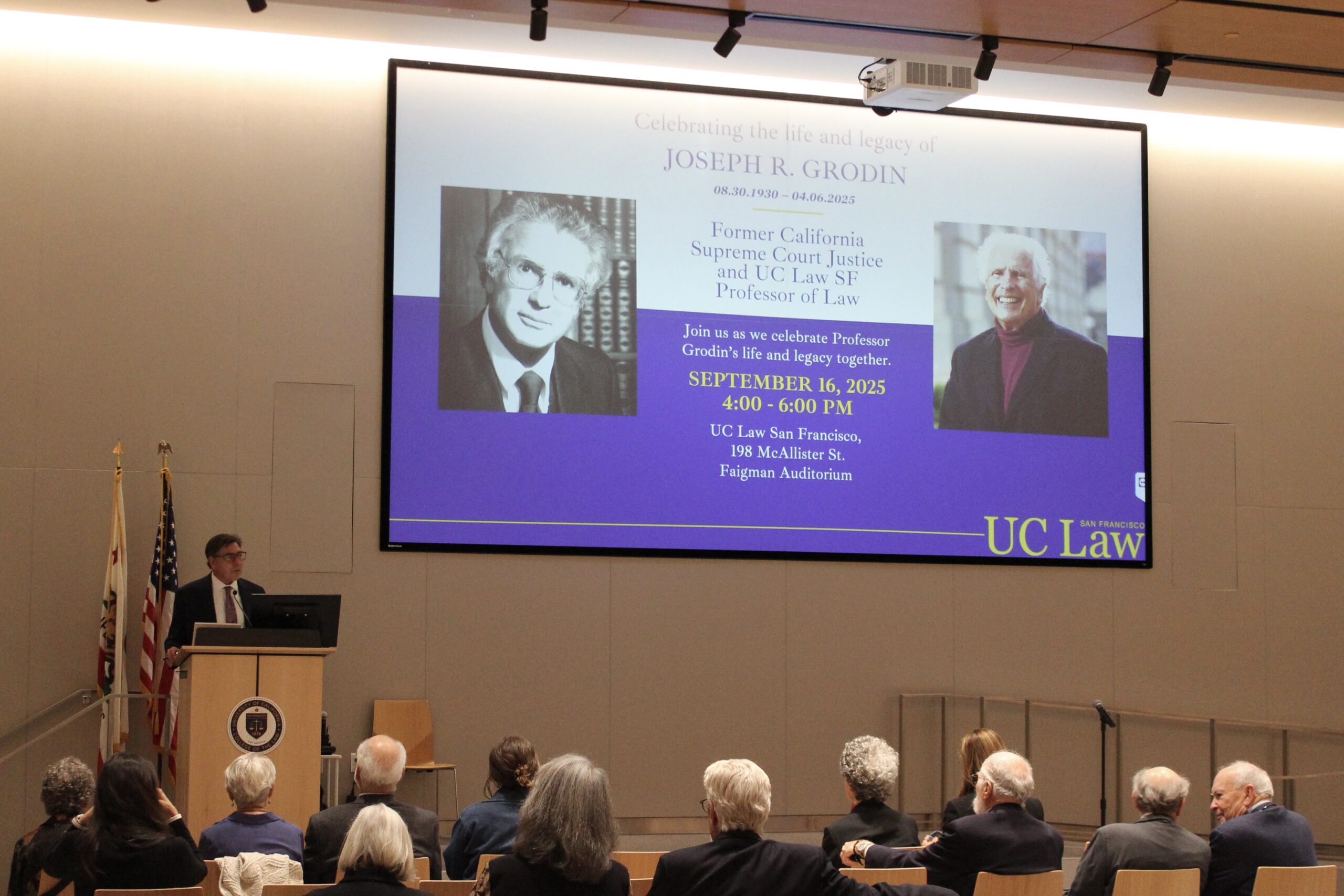
Chancellor & Dean David Faigman speaks at a Sept. 16 memorial celebrating the life and legacy of Joseph R. Grodin, a beloved professor, justice, and mentor whose intellect and compassion shaped generations of lawyers and legal scholars.
- Former California Supreme Court Justice and UC Law SF Professor Joseph R. Grodin was remembered for his brilliance, integrity, and compassion at a Sept. 16 ceremony.
- Grodin transformed UC Law SF’s curriculum, advancing clinical legal education and modernizing approaches to teaching labor, constitutional, and statutory law.
- He inspired students and colleagues with his warmth, intellect, and unwavering belief in the law as a tool for justice.
Curiosity, intellect, compassion, and a steadfast belief in the law as a tool for justice. These are the qualities that defined former California Supreme Court justice and longtime UC Law San Francisco Professor Joseph R. Grodin, as recounted by the friends, colleagues, students, and family members who gathered to honor him during a Sept. 16 memorial ceremony at UC Law SF.
“Joe was brilliant, but he was so much more than extraordinarily smart and learned,” said Emeritus Professor Mark Aaronson, who worked with Grodin to launch UC Law SF’s Employment Law Clinic in the early 1990s. “He was wise, caring, trustworthy, dependable, and compassionate. To use the Yiddish word, he was the epitome of a mensch.”
A Life in Law and Teaching
Grodin, who died April 6 at age 94, helped modernize UC Law SF’s curriculum during his two stints as a UC Law SF professor. He first joined the faculty in 1972 after years of working as a labor lawyer at the firm founded by his friend and mentor Matthew Tobriner, also a former UC Law SF professor and California Supreme Court justice.
Carol Chodroff ’04 remembers Grodin as a gifted teacher whose brilliance, humility, and humor inspired her to love the law and believe in its power to create a better world.
Grodin reshaped UC Law SF’s labor law curriculum in the 1970s, becoming the first faculty member to teach employment discrimination law. He also became a leading scholar in an emerging field at the time, public sector labor law.
Professor Reuel Schiller, who grew close with Grodin after joining the faculty in 1996, recalled his friend and mentor’s influence on the law and legal education.
“I am personally incredibly grateful to have known him because I benefitted tremendously,” Schiller said. “What I wanted to emphasize is that our school and our state did as well.”
Senior U.S. Ninth Circuit Judge Marsha Berzon remembered co-teaching a seminar with Grodin on major pending constitutional law cases. She praised his deep command of doctrine, his foresight in anticipating future legal disputes, and his gift for storytelling that brought the law to life.
“In the classroom, as behind the lawyer’s podium and on the bench, Joe Grodin transformed the various legal roles he has encountered, bringing to every task his bounty of energy, felicity of language, depth of thought, good humor, and profound commitment to shaping a better society,” Berzon said.
Berzon noted that even later in life, Grodin’s curiosity never dimmed. In retirement, he organized book clubs, launched an advocacy group for lawyers concerned about the rule of law, and started a lecture series at his senior living community.
An Influential and Distinguished Public Servant
Grodin also played a pivotal role in advancing labor rights. In 1975, he was appointed as an inaugural member of the California Agricultural Labor Relations Board (ALRB), created to enforce farmworkers’ rights to unionize.
Professor Reuel Schiller praises Joe Grodin’s role in modernizing UC Law SF’s curriculum, from introducing employment discrimination law to shaping a required first-year course on statutory interpretation and the administrative state.
Ellen Lake, who worked with Grodin as counsel for the board, described him as the board’s “intellectual leader.” She credited him with shaping groundbreaking rules, including one that ensured union organizers could access worksites to speak with employees. More than 50,000 farmworkers voted in over 400 union elections during the board’s first six months, Lake said.
“Joe loved the law and he loved to work for justice,” Lake said. “He was proud to serve on the ALRB because it allowed him to advance the rights of the most downtrodden of California workers, namely migrant farmworkers.”
In 1979, Grodin was appointed to the California Court of Appeal, where he authored the landmark Pugh v. See’s Candy decision, establishing that employment contracts may carry an implied promise of termination only for good cause. Three years later, he rose to the California Supreme Court.
His tenure ended in 1986 after a contentious election in which critics painted him and two colleagues who opposed the death penalty as soft on crime. Several faculty members described it as a loss for California but a gain for UC Law SF, where Grodin returned in 1987.
In his second stint on the faculty, Grodin co-led an effort to make a course on statutory interpretation and the administrative state required for first-year law students — an approach that later became standard at law schools nationwide. He remained on the faculty until his retirement from full-time teaching in 2005.
A Teacher Who Cared
Multiple speakers emphasized not only Grodin’s intellect but his kindness. Chancellor & Dean David Faigman, who joined the faculty in 1987, recalled Grodin’s patience in the classroom and use of the Socratic method to gently guide students toward their own insights.
He also noted Grodin’s unmatched status as a gifted thinker and writer who combined deep curiosity and scholarly rigor to make a lasting impact on the legal profession.
“We’re a lesser community because of our loss,” Faigman said, “but we’re a much greater community to have known Joe and learned from him and been a part of the life that he led.”
Sharon Grodin describes how her father’s warmth and compassion touched everyone around him, including his students, faculty colleagues, and fellow judges.
Grodin’s former student Carol Chodroff ’04 said the professor’s warmth, humor, and expert storytelling skills made the law come alive. She emphasized how he cared deeply, not just about the law, but also for his students.
“His brilliance, his kindness, his humility, his humor—his inspiration taught me to love the law and to believe that, together, we can bridge the gap between the world that is and the world that ought to be,” Chodroff said.
“A Really Cool Dad”
One of the most personal tributes came from Grodin’s daughter Sharon Grodin, who shared a memory from her visit to one of his classes. After taking part in a roleplaying exercise, she was stopped on her way out by an eager student with a question that would stay etched in her memory. The question: “Was he a really cool dad?”
“Just the fact that the question arose says so much about who my dad was to his students and colleagues, and who they were to him,” she said. “Whether you were a student, faculty member, or a fellow judge, you were on Team Joe … And yes—he was a really cool dad.”
Oct. 3 Memorial Event
Grodin’s influence as a California justice and legal scholar will be further discussed at an Oct. 3 memorial event at UC Law San Francisco. The event is co-presented by the UC Law Journal, UC Berkeley Law’s California Constitution Center, and the California Supreme Court Historical Society.