California Supreme Court Justice Leondra Kruger Shares Advice on Advocacy, Duty to the Law with UC Law SF Students
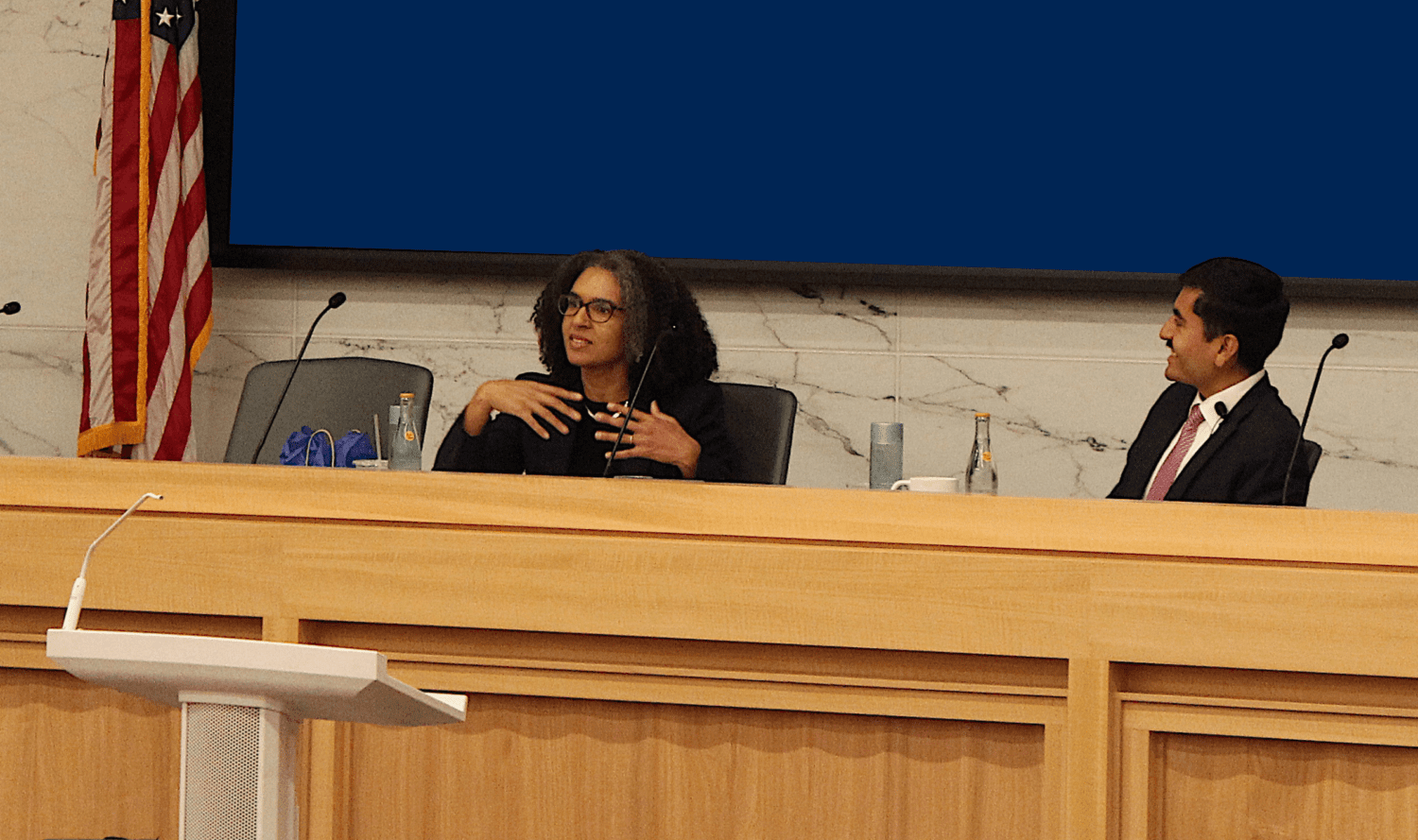
In a discussion with law students, California Supreme Court Justice Leondra Kruger underscores how lawyers help build public trust in the judiciary through principled conduct and effective communication.
- California Supreme Court Justice Leondra Kruger shared insights from her journey from law student to the state’s highest court, highlighting how a calling to serve the public good guided her career.
- She spoke with students about the importance of understanding one’s audience, collaborating with colleagues to reach sound decisions, and overcoming self-doubt through purpose-driven work.
- Kruger emphasized that lawyers play a vital role in strengthening public trust in the courts through integrity, professionalism, and clear communication.
After shaping California law for nearly a decade on the state’s highest court and serving in some of the U.S. government’s most influential legal roles, California Supreme Court Justice Leondra Kruger has gained a wealth of insight over her 24-year career.
Kruger shared some of that wisdom with law students while visiting UC Law San Francisco in October for a conversation hosted by the College’s Moot Court Team.
Speaking with Moot Court Board Co-Chair Samuel Aguilar ’26, Kruger reflected on her path from law student to justice, her approach to deciding cases, and the vital role of trust in the judiciary. She also offered practical advice for future attorneys.
“The most fundamental rule of advocacy is try to put yourself in the shoes of the person who’s making the decision,” Kruger said.
She urged students to understand their audience — not only to connect with judges and juries but also to better anticipate and counter opposing arguments.
Even with a distinguished career in law, Kruger said she didn’t always envision herself as an attorney. Popular portrayals of lawyers as showy courtroom performers initially turned her away from the field. But in college, she discovered the many ways a legal education could be used to “contribute to the public good.”
After earning her bachelor’s degree from Harvard, Kruger studied law at Yale, where she built lifelong friendships through organizations including the Black Law Students Association and the Yale Law Journal, on which she served as editor-in-chief.
Like many law students, Kruger sometimes struggled with feelings of self-doubt. Her strategy for overcoming them, she said, was to focus on the larger purpose behind her work.
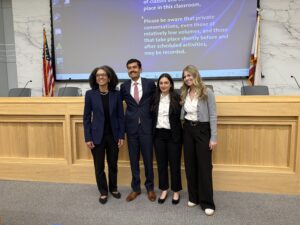
After speaking with law students about integrity and her duty to the law, Justice Leondra Kruger meets with Moot Court Board Co-Chairs Samuel Aguilar, Aleen Babikian, and Kat Simons.
She recalled telling herself, “It’s not about you,” whether preparing for class or standing before the U.S. Supreme Court, where she argued 12 cases as an assistant to the U.S. solicitor general and acting deputy solicitor general under Presidents George W. Bush and Barack Obama.
“I had to remind myself to get over whatever hangups I had about whether I was up to the task,” she said. “It was about representing someone’s interests that transcended my own.”
Following six years in the Solicitor General’s Office, Kruger served as deputy assistant attorney general in the U.S. Department of Justice’s Office of Legal Counsel, which advises the president and federal agencies. While at the Department of Justice, she helped defend the Affordable Care Act and implement the Supreme Court’s 2013 decision in United States v. Windsor, which struck down parts of the Defense of Marriage Act.
In 2014, Gov. Jerry Brown appointed Kruger to the California Supreme Court, where she was sworn in the following year. Since then, she has contributed to major opinions on issues ranging from criminal trial procedures and biometric data collection to workers’ rights.
Kruger described her judicial philosophy as one grounded in understanding and collaboration.
“When dealing with the most difficult questions facing our system, we give better answers when we collaborate,” she said. “That doesn’t mean we always agree, but it helps when we come from a place of doing our very best to see eye to eye on an issue.”
She also addressed the declining public trust in government institutions, including the courts. Judges, she noted, are called to make decisions based on the law — not on popular opinion.
“The votes I cast in cases — it’s not necessarily because I like the outcome. Often, I don’t,” she said. “It’s because I have a duty to uphold the laws of the State of California and the United States.”
Kruger reminded students that lawyers share responsibility for maintaining confidence in the judicial system.
“What you do and say, how you communicate about your client’s causes and the work of the courts matters tremendously,” she said. “It helps promote that sense of public confidence in the courts as the proper forum for resolving our most difficult challenges and disputes.”