Experts unpack major Supreme Court cases in UC Law SF panel talk
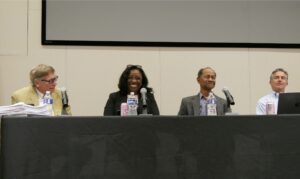
Professor Rory Little and U.S. District Judge Trina Thompson join Professors Richard Boswell and Scott Dodson to examine the legal and societal implications of Supreme Court decisions.
- U.S. Northern District of California Judge Trina Thompson joined three law professors to review major Supreme Court cases at a talk in September.
- The panel discussed public trust in the judiciary and examined cases involving data privacy, criminal appeals, immigration enforcement and civil procedure.
- Upcoming cases could affect gun rights, property seizures and the limits of government power.
Three law professors and a federal judge examined Supreme Court cases involving executive power, individual rights and immigration policy during a recent panel discussion at UC Law San Francisco.
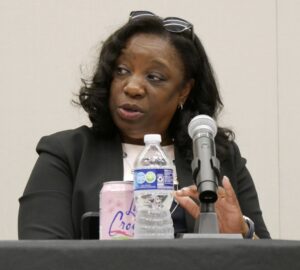
U.S. District Judge Trina Thompson says judges can strengthen public trust in the courts by thoroughly explaining their decisions and remaining open to scrutiny.
Professors Rory Little, Richard Boswell and Scott Dodson joined U.S. Northern District of California Judge Trina Thompson for the law school’s 29th annual Supreme Court Review and Preview on Sept. 30.
Thompson discussed Louisiana v. Callais, on the role of race in drawing voting districts, and Olivier v. City of Brandon, in which the court unanimously ruled that a street preacher can sue over restrictions on where people can protest. She said the cases show how the court’s decisions shape political representation and individual rights, and that the justices can agree on major constitutional questions.
She also addressed Trump v. Barbara, where the court rejected the Trump administration’s effort to end birthright citizenship by executive order. The case raised questions about presidential authority and the meaning of the 14th Amendment’s Citizenship Clause.
“The decision illustrates how constitutional interpretation can place the judiciary directly in the middle of some of the most consequential disputes in American life,” Thompson said.
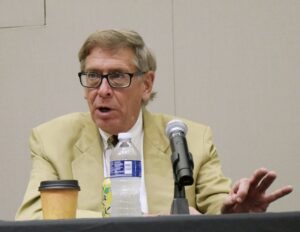
Professor Rory Little explains how rulings on criminal appeals and cellphone location tracking shape the rights of people facing criminal investigations and prosecution.
Little, who organized and moderated the panel, reviewed criminal cases from the court’s most recent term. In Chatrie v. United States, the court ruled that people have a reasonable expectation of privacy when it comes to cellphone location data held by companies such as Google. In Hunter v. United States, the court held that a defendant can sometimes appeal a conviction or sentence after agreeing to waive that right. The case raises questions about whether agreements are truly voluntary when people are under pressure, including in plea deals and consent to police searches.
Little said Hunter is “the most important criminal case of the term which no one’s heard of because it really puts things into doubt.”
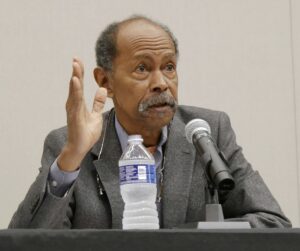
Professor Richard Boswell discusses how a surge in legal challenges to immigration detention is straining federal courts and prosecutors.
Looking ahead, Little previewed two cases the court will hear this fall. One could decide if states and local governments can ban AR-15-style rifles. Another asks if Alaska’s seizure of an airplane used to haul a locally banned six-pack of beer is an excessive penalty under the Eighth Amendment.
Boswell, an immigrants’ rights expert, focused on cases involving the Trump administration’s immigration policies, including mass arrests and deportation, incarceration, elimination of prosecutorial discretion, firing of immigration judges and efforts to limit federal court review. He said immigrants challenging their detention have prevailed in the vast majority of nearly 80,000 habeas corpus cases brought in response to these policies, and that the caseload is placing enormous strains on courts and prosecutors.
“What [U.S. attorneys] are not doing when they’re in there on a habeas case … is they’re not dealing with serious crimes,” Boswell said. “They’re not dealing with drug trafficking and human trafficking.”
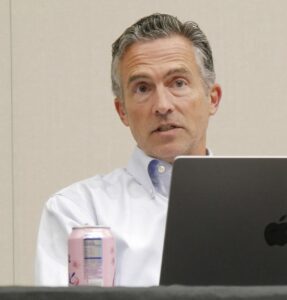
Professor Scott Dodson examines how technical rules about filing deadlines and court procedures can have significant consequences for litigants.
Dodson, director of UC Law SF’s Center for Litigation and Courts, analyzed rulings on civil procedure. He praised three unanimous decisions, including Berk v. Choy, which held that extra filing requirements for medical-malpractice claims in Delaware and other states don’t apply in federal court when they conflict with federal rules.
Dodson criticized other rulings, including Enbridge Energy, LP v. Nessel, which held that a 30-day deadline for removing a lawsuit from state to federal court cannot be extended through equitable tolling. Since the Court decided the issue under facts that would not justify equitable tolling anyway, he said it was unwise to use the case to reject equitable tolling for all cases. He argued that, in procedure cases, the Supreme Court should defer more to the views of procedure experts, such as professors, lower courts, and the federal rules advisory committees.
“The court should approach matters of federal civil procedure with a certain humility,” Dodson said.
Thompson emphasized the importance of public trust in the courts, especially as judges are increasingly viewed through a political lens. That trust, she said, cannot rest on whether people agree with every decision.
“The legitimacy of the judiciary does not come from being right in the eyes of everyone,” she said. “It comes from being faithful to the law, honest about the reasoning, open to scrutiny, and committed to treating every person who enters the courtroom with dignity.”