Oakland Mayor Barbara Lee Reflects on Decades of Public Service in Jackie Speier Lecture

Federal-lawmakers-turned-local-electeds Jackie Speier ’76 and Barbara Lee explore how experience, activism, and courage shape effective leadership, offering students a window into the real-world challenges and responsibilities of public service.
- Barbara Lee reflected on a career spanning Congress and now Oakland mayor, highlighting lessons from activism, policy, and public service in a conversation with alumna, former Congress member and current San Mateo County Supervisor Jackie Speier ’76.
- Lee discussed the importance of principled decision-making, including her stand against broad executive military authority after 9/11.
- The lecture emphasized mentorship, civic engagement, and inspiring the next generation of law and community leaders.
Speaking at UC Law San Francisco, former U.S. Representative Barbara Lee reflected on a warning she issued nearly 25 years ago — one that resonates today as the Iran war dominates headlines.
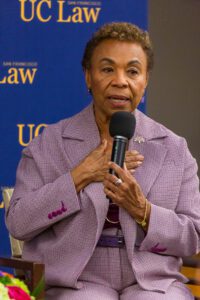
Barbara Lee tells UC Law SF students how concerns about separation of powers informed her decision to oppose broad executive war authority after the 9/11 terror attacks.
“I said, ‘This is going to set the stage for forever wars,’” Lee recalled. “This is giving any president the authority to go to war in perpetuity.”
Just three days after the September 11 attacks, Lee cast the only vote in Congress against a measure granting broad presidential authority for the use of military force. Now serving as Oakland mayor, she discussed that decision and more in a conversation with former U.S. Representative Jackie Speier ’76, who now serves on the San Mateo County Board of Supervisors.
The March 24 event was the most recent installment of the “Jackie Speier Lecture on Women and the Law,” which aims to amplify the voices of women leaders and inspire future generations.
Lee traced her commitment to justice to her youth in Southern California, where she worked with the NAACP to successfully challenge a policy that excluded nonwhite girls from her high school cheerleading squad.
Later as a student at Mills College, she raised two children while relying on public assistance, often bringing them to class with her because she couldn’t afford child care.
“That’s how I raised my kids,” Lee said, explaining her opposition to cutting safety-net programs.
A turning point came when she met Shirley Chisholm, the first Black woman elected to Congress and a 1972 candidate for the Democratic presidential nomination. Chisholm encouraged Lee to vote and get engaged in politics — advice Lee now shares with young people.
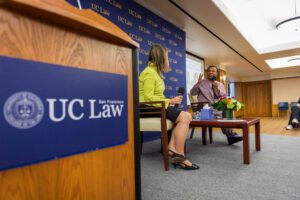
Jackie Speier ’76 asks Barbara Lee how her civil rights advocacy, community activism, and economic hardship as a young mother shaped her approach to lawmaking, politics, and leadership.
Lee also supported the Black Panther Party’s community service programs, including a free breakfast program, and later worked on party co-founder Bobby Seale’s 1973 mayoral campaign.
Lee said those experiences shaped her belief in government’s responsibility to meet people’s basic needs — a perspective that guided her in Congress.
On Sept. 11, Lee recalled evacuating the Capitol and seeing smoke rise from the Pentagon. Though shaken and angry, her background in psychology and social work gave her pause when asked to approve expansive presidential war powers.
“You don’t make critical decisions in the midst of turmoil, anger, or grieving,” she said.
After efforts to limit the authorization for military force failed, Lee voted no — alone. She faced death threats and was labeled unpatriotic but also received support from leaders including Desmond Tutu and Coretta Scott King.
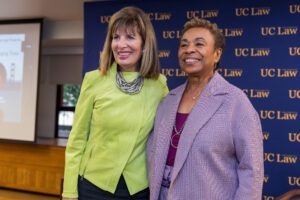
Jackie Speier ’76 and Barbara Lee describe working with political opponents in a divided Congress — showing how unlikely alliances can turn urgent ideas into polices that expand rights, advance justice, and save lives.
Despite political divisions, both Democrats emphasized bipartisan collaboration. Speier cited her work with a Republican colleague on sexual harassment policy reform for House members and staff, while Lee pointed to her partnership with George W. Bush on the global HIV prevention and treatment program PEPFAR, which has saved more than 25 million lives.
“Everything George Bush stood for, I was against,” Lee said. “But I talked to him about helping me save lives … I wrote PEPFAR. He signed it into law.”
Now serving as Oakland’s first Black woman mayor, Lee said she draws on decades of experience to address challenges from public safety to homelessness.
“Being mayor, you just garner everything that you have learned over the years,” she said.
She pointed to signs of progress, including declining crime rates, a bustling food scene, and a growing cultural profile, with artists and athletes including filmmaker Ryan Coogler and Olympic gold medalist Alysa Liu calling Oakland home.

After the talk, Barbara Lee and Jackie Speier ’76 meet with UC Law San Francisco students, posing for photos and encouraging them to pursue purpose-driven legal careers.
“Our trajectory is going in the right direction,” Lee said.
Speaking to law students, Lee and Speier urged them to use their degrees to make an impact.
“A law degree gives you an opportunity to do a lot, whether it’s corporate, criminal, research, or teaching,” Lee said. “You can use it for what you think the world needs.”
For Lee, hope lies in the same place her own journey began: giving young people the type of encouragement she received as a college student from the legendary Shirley Chisolm.
“Working with young people is really amazing because they see very clearly what the issues are … how we have not lived up to our creed of liberty and justice for all,” Lee said. “Helping them see why they have to be engaged on some level … that gives me a lot of hope.”