Farzad Tabatabai '95 enters boxing hall of fame, without ever throwing a punch
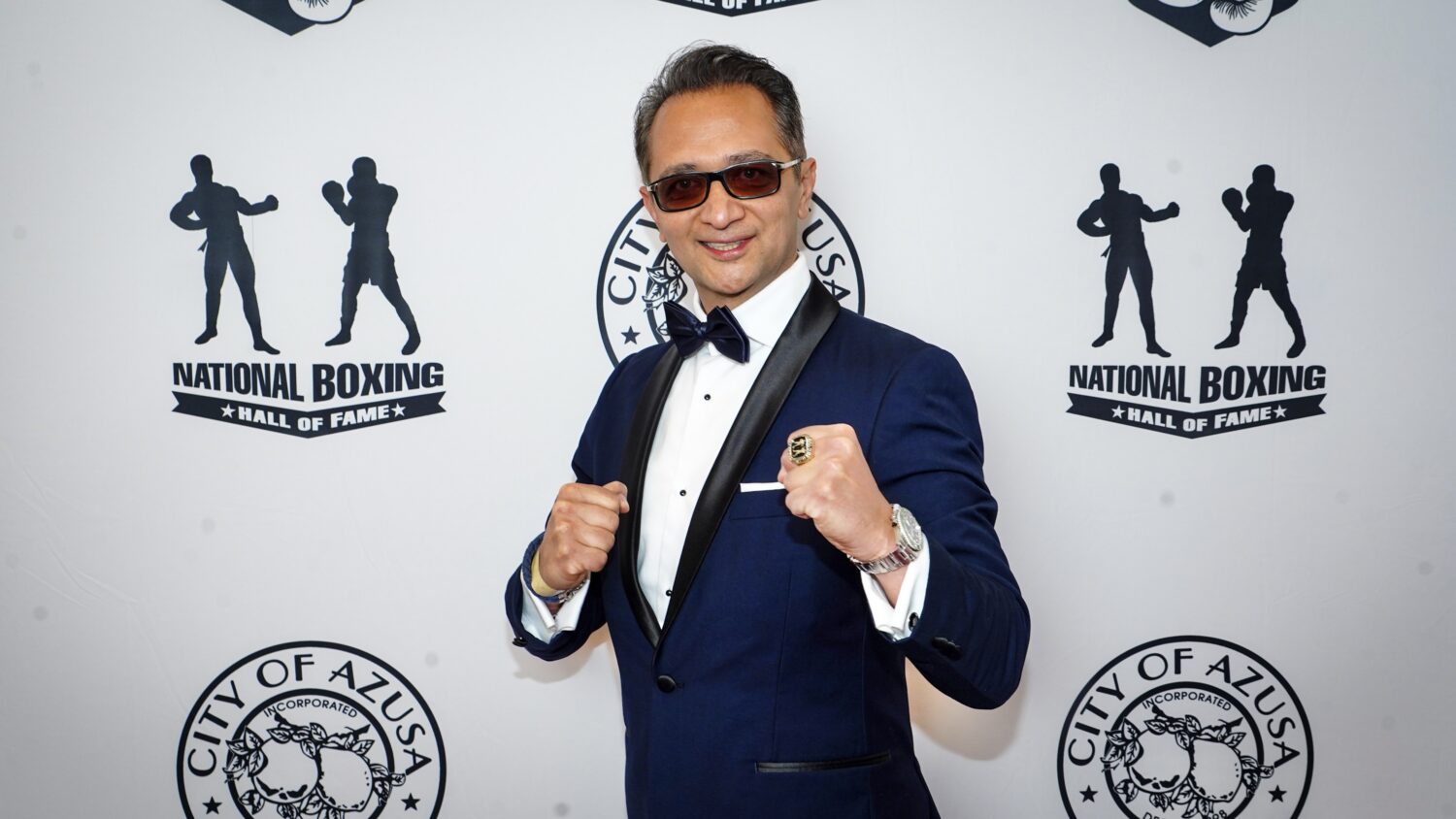
Farzad Tabatabai ’95 has developed a national reputation in the highly specialized field of boxing law.
- Farzad Tabatabai ’95 entered the National Boxing Hall of Fame without ever stepping into the ring as a boxer.
- His legal bouts have involved championship fights, athletic commissions, and international law.
- He encourages aspiring lawyers to master the fundamentals, think independently, and never limit their ambitions.
UC Law San Francisco alumnus Farzad Tabatabai ’95 has spent decades fighting in the world of boxing. He’s just never done it in a ring.
This year, Tabatabai was inducted into the National Boxing Hall of Fame, recognizing his two decades of legal work representing fighters, promoters, managers, and fans in some of the sport’s most complex disputes.
“It’s a great honor,” he said. “As a lawyer and a litigator, you are a fighter — but in a different arena. We use our intellect, our words, and our wit, rather than our fists.”
Over the past 20 years, Tabatabai has built a unique practice at the intersection of athletics and the law. He has challenged California boxing regulations, litigated disputes between fighters and promoters, secured reimbursements for fans when matches were canceled, and represented clients before state and federal courts in California and Puerto Rico, as well as athletic commissions in California and Nevada — navigating everything from contract and administrative law to international disputes.
“It’s a lot of issues that a typical lawyer wouldn’t usually come across,” he said.

Farzad Tabatabai credits his success to a simple approach: study the rules, question assumptions, and let the law guide the outcome.
Finding his path to law
Born in Iran, Tabatabai came to the United States as a child shortly before the 1979 Iranian Revolution. What began as a family vacation turned into a permanent move, with his family eventually settling in Southern California. Though his father had served as a high-level judge in Iran, Tabatabai initially planned to pursue engineering — until he was drawn to the law’s role in addressing injustice and creating change.
After studying political science and economics at UC Irvine, he enrolled at UC Law San Francisco, then known as UC Hastings. He credits professors there with helping shape his approach to the law: the late C. Keith Wingate instilled the importance of rigorous preparation, while the late Justice Joseph Grodin taught him to approach legal questions with a clear and open mind.
That approach carried into his boxing work.
“I came to boxing with no preconceptions or knowledge of the rules,” he said. “I learned by going to the source — reading the cases, statutes, rules, and regulations.”
A title bout and a turning point
After graduating, Tabatabai worked as a Los Angeles County Superior Court research attorney and later as a litigator for multiple law firms before launching his own practice, now called Tabatabai & Miyamoto APC.
His entry into boxing came through a client invested in a promotion company, and he quickly found himself in the deep end: a high-stakes dispute over a welterweight championship bout between Antonio Margarito and Paul Williams.
With only 72 hours’ notice, Tabatabai flew to Puerto Rico for an emergency federal bench trial that would determine whether the fight could proceed.
“I’ve never been more exhausted walking into a courtroom,” he recalled. “I argued as best as I could, and the judge agreed with me.”
The match went forward, Williams won, and it was the first boxing match Tabatabai had ever attended. The case launched a career taking on some of the sport’s most powerful institutions and litigating issues that touch nearly every aspect of the industry.
Farzad Tabatabai used his Hall of Fame acceptance speech to highlight the often-unseen legal battles that shape the sport of boxing.
A rare Hall of Fame honor
Tabatabai never expected that work would land him in the National Boxing Hall of Fame. He had crossed the goal off his bucket list years earlier, convinced it was unrealistic for a lawyer who’d never stepped into the ring. But he was named an inductee this year.
“I was very surprised when I found out,” he said. “I now tell people: Anything is possible. Don’t self-censor your list.”
He accepted the honor at an April 26 ceremony in Montebello, California. According to his research, no other attorneys have been inducted into an athletic hall of fame purely for their legal work within a sport.
“It’s an honor not only for me, but for the entire legal community,” he said.
For today’s law students, he emphasizes mastering the fundamentals: “Look things up. Analyze the cases. Think through these problems,” he said. “AI could not make the legal arguments I’ve made or the strategies I’ve come up with.”
And for those hoping to break into sports or entertainment law, his advice is straightforward: pursue opportunities, ignore the doubters, and if you fall, get back up and keep fighting.
“Get your foot in the door,” he said. “Don’t listen to the naysayers and negative voices in your head. If it doesn’t happen, keep trying. At least you’ll know you gave it your best shot.”