Prof. Hadar Aviram inspects biblical stories of incarceration with modern lens in new book

Professor Hadar Aviram explores biblical stories of imprisonment and what they reveal about the history of confinement in new book.
- Prof. Hadar Aviram investigates narratives of incarceration in the Hebrew Bible as part of a broader inquiry into the history of confinement.
- Her research identifies carceral themes that recur across time, including the role of food in exercising power, political repression, marginalized populations and the transformation of people held behind bars.
- Her work offers law students a wide framework for examining crime and punishment, linking ancient legal thought to modern debates over justice, power and rehabilitation.
In her fifth book, “Behind Ancient Bars: Narratives of Incarceration in the Hebrew Bible” (UC Press), Professor Hadar Aviram explores biblical stories of imprisonment and what they reveal about the history of confinement. Aviram, the Thomas E. Miller ’73 Professor of Law at UC Law San Francisco and a rabbinical student at Hebrew Union College, is a scholar of criminal justice, civil rights, law and politics, and social movements. In this Q&A, she discusses the book’s findings and their relevance to contemporary views of crime and punishment.
What inspired your focus on biblical stories of incarceration?
This project combines my decades-long expertise in incarceration and prison conditions with my new interests in Jewish studies and rabbinics. Criminological and penological scholarship tends to see prisons as a new phenomenon, that goes hand in hand with modernity, capitalism, technology, etc. But it turns out that people have locked each other up to accomplish political goals, and created bureaucracies that accompanied this phenomenon, for thousands of years. There is wonderful new literature in ancient history and archaeology showing how carceral facilities and programs show up in documents and in material culture. My book contributes a biblical dimension to this exciting new scholarship.
What surprised you most in your research?
There are certain aspects of incarceration that we tend to consider in modern terms but have actually been part and parcel of incarcerating people for a very long time. For example, prisons struggle with the challenge of feeding incarcerated people properly — giving them food that is sufficient, nutritionally appropriate, and, when relevant, culturally sensitive. Food can be a tool of oppression and also a tool of resistance. This is something that came up quite a bit in my work on California prisons, both during the Pelican Bay hunger strike and during COVID-19, and has gone hand in hand with incarceration for millennia. Chapter 1 of the Book of Daniel tells the story of incarcerated children who try to get some autonomy, some control, over what they are fed. Similarly, the story of the Scroll of Esther indicates that women who end up caught in carceral facilities often have had a marginalized life pre-incarceration.
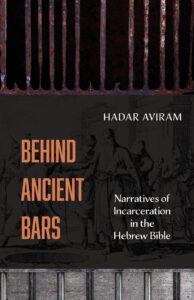
Aviram’s work offers law students a wide framework for examining crime and punishment, linking ancient legal thought to modern debates over justice, power and rehabilitation.
How is this ancient lens relevant to the present and our American judicial system?
We have to be cautious about presentism, but there are definitely themes that are perennial. Some of the questions we tend to address as parochial and particular actually resonate across times and societies. Consider the question we find ourselves pondering a lot in the last decade or so — do governments facing a legitimacy crisis tend to punish dissidents more harshly? If we read the story of Jeremiah 37-38, we’ll find a realistic and astute analysis of how a weak monarch in the clutches of a fragile coalition tries to consolidate his power by harshly punishing a popular, outspoken dissident. The problems we have today go beyond individual personalities and particular circumstances — they are universal and have a lot to do with how people wield power and authority over each other.
U.S. prisons are considered part of a “correctional” system. Was incarceration viewed as having some redemptive value in the ancient stories?
The biblical stories do not show that prisons were, or even purported to be, a means of rehabilitation. However, all the stories are infused with the idea that being behind bars changes people. The story of Joseph (Gen. 39-41) is a great example. We have a young man who starts off being cocky and arrogant, irritating his brothers with tales of his dreams that make him superior to them. Then we see him behind bars interpreting his fellow inmates’ dreams, and we see that he’s acquired some humility, diplomacy, a sense of wisdom and the ability to get along with other people. These changes have been identified in the classic penological literature of the 1960s as “prisonization”— adaptations to life behind bars — but in the biblical stories, they serve a goal that echoes the Hero’s Journey as explained by Joseph Campbell. The prison becomes sort of a crucible of transformation, a place in which heroes are forged, where they discover the power that later gives them key roles in the biblical narrative.
What lessons can law students draw from this research?
I hope the book will inspire students to challenge some of the basic assumptions of our field and expand the way we think about crime and punishment. Many of the legal questions we face today — questions of mental state, intent, negligence, damages, fault, etc. — existed many centuries ago, and people came up with logical structures to resolve them. The study of analogies, deductions, inductions, how contradictions are resolved, etc., can shed some light on the logics that inform today’s constitutional and legal questions, and can help sharpen our logic and argumentation skills.