Prof. Jon Abel’s Research Challenges Assumptions About a Widely Debated Gun Law
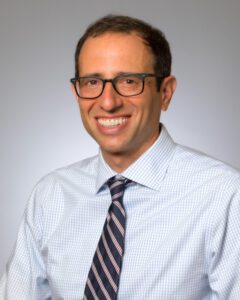
Professor Jonathan Abel, an award-winning criminal justice scholar, examines how felon-in-possession laws are applied in California and what the data reveal about fairness, public safety, and racial disparities.
Faculty Who Lead: Jonathan Abel
- Prof. Jonathan Abel analyzed 27,000 California felon-in-possession cases to understand how the state’s most common gun charge is applied.
- He found that most defendants lacked prior violent felony convictions and that Black and Latino individuals were disproportionately charged.
- These findings challenge common narratives in national gun debates and highlight the need for data-driven policy discussions.
Professor Jonathan Abel has spent years digging into the hidden corners of the criminal justice system – work that previously earned him an award for scholarly excellence. His past projects have tackled issues ranging from police officers’ social media posts and the secrecy of police misconduct files to a comparative analysis of state and federal gun law prosecutions. He currently holds the title of Harry & Lillian Hastings Research Chair, which recognizes tenured faculty for outstanding published research and promising future scholarship.
In his latest study, Abel analyzed a sweeping dataset of all 27,000 felon-in-possession-of-a-firearm cases in California courts over four years to test common assumptions about how the law is applied. His findings reveal patterns about racial disparities, the treatment of people with different types of criminal histories, and the real-world impact of a statute at the center of national debates over crime and public safety. Here, Abel discusses some of the biggest takeaways from his forthcoming study, Disarming Data: An Empirical Take on the Loaded Debate about Felon-in-Possession of a Firearm.
Q: What commonly held assumptions inspired you to investigate how felon-in-possession laws are applied in California?
A: There are two commonly held assumptions about felon-in-possession prosecutions — and they are in direct tension with each other. Some see this crime — the most frequent gun charge in the nation — as a common-sense safety measure. These people assume that having a felony conviction is a good proxy for a person’s dangerousness. On the other side of the debate, people see felon-in-possession as an overbroad offense that punishes nonviolent defendants, often in racially discriminatory ways. These critics believe that a felony conviction is not a good proxy for a person’s dangerousness. I realized that both sides of this debate lacked information on a crucial empirical question: How often do felon-in-possession defendants have violent felony convictions in their background, and how often not? The answer would help move the debate forward by showing whether prosecutors are primarily using the charge to go after those convicted of violent crimes or applying it indiscriminately.
Q: What did the data show about patterns in who gets charged with this crime?
A: The data showed that 8.5% of felon-in-possession defendants had a conviction for a violent felony, as defined by the California Penal Code. Using a somewhat broader definition of “violent,” I found that 28.8% of felon-in-possession defendants had a prior conviction for a violent felony. Regardless which number one uses, the data suggest that felon-in-possession prosecutions are not primarily targeting those with violent felony convictions. The paper notes the many difficulties in defining what counts as “violent” and in drawing assumptions from a person’s criminal history to their current behavior. The data also confirmed fears about racial disparities in prosecutions, showing that Black and Latino defendants are overrepresented not only compared with population demographics but also compared with their proportion among all felony defendants.
Q: How does the process differ for people with different types of past convictions?
A: The data also included information on an “aggravated” form of the crime—a charge that is specifically targeted at those who possess a gun and were convicted of a “violent felony,” as defined by the California Penal Code. It was interesting to discover from the data that prosecutors under-charge the crime of “violent felon-in-possession.” That is, they charge this aggravated version of the crime in only about 27% of the cases where they could charge it. This is ironic. Considering how often felon-in-possession is charged against those with nonviolent felony convictions, why are prosecutors not charging “violent felon-in-possession” as often as they could?
Q: What do you hope policymakers and the public take away from these findings?
A: Felon-in-possession is the most common gun crime in the country, both in the federal and state systems. I hope policymakers will see that felon-in-possession is largely not being targeted at those with violent felony convictions. That does not mean it is inherently a bad policy decision to keep this law on the books. But it does require a more rigorous conversation about why nonviolent felons are prohibited from possessing guns, especially in light of the racial disparities that these prosecutions cause. Only by grounding that debate in data can we move forward on it.
Abel’s scholarly research focuses on informational asymmetries in the criminal justice system and the structural injustices these asymmetries produce. His articles have appeared in the Yale Law Journal, Columbia Law Review, and Stanford Law Review.
Prior to becoming a law professor, Abel worked as a criminal defense lawyer doing capital habeas corpus litigation and direct appeals. He has served as an attorney at the Habeas Corpus Resource Center, the Northern California Federal Defender’s Office, and the Arizona Federal Defender’s Office. Before law school, he worked as a newspaper reporter at the St. Petersburg Times, covering criminal justice and local government.