Karen Korematsu urges UC Law SF grads to carry on her father's legacy of defending constitutional rights
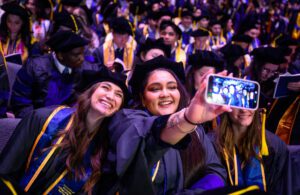
Class of 2026 graduates smile during UC Law SF’s 145th commencement ceremony as they prepare to use their legal training to make a difference in the legal profession and beyond.
- More than 350 graduates received degrees at UC Law SF’s 145th commencement ceremony at the Bill Graham Civic Auditorium on May 11.
- Keynote speaker Karen Korematsu urged graduates to defend constitutional values, invoking her father Fred Korematsu’s legal fight against the internment of Japanese Americans during World War II.
- Graduating student speakers encouraged classmates to use their education to strengthen the legal system and lead with courage and integrity.
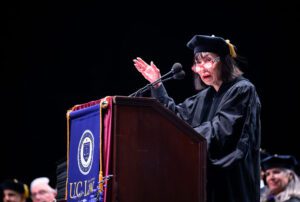
Drawing on her father’s legacy of opposing mass violations of constitutional rights, Karen Korematsu reminds UC Law SF graduates that the Constitution relies on lawyers willing to defend its principles.
Invoking her father’s decadeslong fight for justice, Karen Korematsu urged UC Law San Francisco’s Class of 2026 to defend the moral principles at the heart of the Constitution.
“Remember my father’s words: stand up for what is right,” she told graduates during the College’s 145th commencement ceremony at the Bill Graham Civic Auditorium. “Don’t be afraid to speak up.”
Korematsu shared the story of her father, Fred Korematsu, who challenged the incarceration of Japanese Americans after refusing to comply with a forced relocation order during World War II. The Supreme Court ruled against him in 1944 in a decision widely criticized for its constitutional deficiencies. His conviction was overturned decades later.
“Fred Korematsu made a difference in the face of adversity,” she told graduates. “So can you.”
Korematsu addressed more than 350 graduates of the College’s Juris Doctor (JD), Master of Laws (LLM), Master of Legal Studies (MLS), and Master of Science, Health Policy & Law (HPL) programs before they crossed the stage, sometimes with their young children in their arms, to receive their diplomas as friends and family cheered.
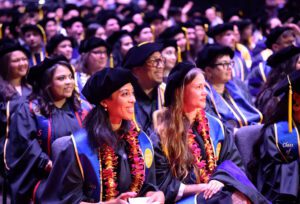
The JD Class of 2026 completed more than 14,000 hours of pro bono service during law school, providing free legal support while preparing for careers rooted in service and advocacy.
Korematsu is a longtime advocate for civil rights and civic education who founded the Fred T. Korematsu Institute in 2009 to honor her father’s legacy. The national organization promotes civil liberties, social justice, civic engagement, and ethnic studies education.
During her remarks, Korematsu described the personal toll her father paid after challenging the incarceration order, including imprisonment, decades of discrimination, and criticism from members of his own community who feared his legal challenge would bring additional hardship to Japanese Americans.
She praised the attorneys who worked pro bono to reopen her father’s case and encouraged graduates to follow that example. Many already have. The Class of 2026 completed more than 14,000 hours of pro bono work, valued conservatively at $1.4 million in legal services.
About 20% of the JD class reached another milestone as first-generation graduates, becoming the first in their families to attend college and earn law degrees.
“We are here today to recognize and honor our graduates, of whom we are all extremely proud,” said Chancellor & Dean David Faigman.
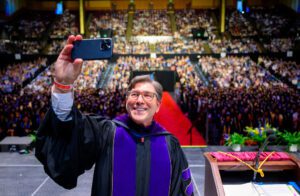
Chancellor & Dean David Faigman takes a selfie photo with hundreds of graduates as they celebrate the start of their meaningful professional journeys.
Before introducing student speakers, Faigman paused the ceremony to snap a selfie photo with more than 350 graduates, drawing cheers from the crowd.
Three graduate speakers then took the stage, each urging classmates to use their legal training in service of something larger than themselves.
JD Class of 2026 Valedictorian Drake Trent, who plans to join Nixon Peabody as a technology and privacy litigator after passing the bar exam, said his law school experience helped him define the kind of lawyer he hopes to become. He credited faculty with shaping that vision, saying they showed him “what it means to be a lawyer who acts with integrity and purpose for the benefit of the world around me.”
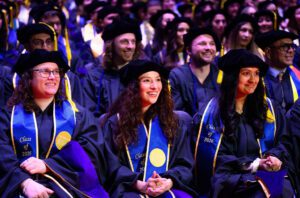
Smiling graduates cheer during the commencement ceremony. They leave law school ready to use their legal education to advocate, lead, and make a an impact.
Selected by JD classmates to speak, Jasleen Gill, who plans to focus on housing and tenants’ rights as a postgraduate fellow, urged her peers to think about how they will apply their legal training. She urged them to help make the legal system “work a little more fairly, a little more humanely, and when needed, build a new one.”
Representing the LLM Class of 2026, Susmita Nanda spoke about the global community of lawyers in her class and the new perspectives it brought to her legal education. She urged graduates to pursue careers rooted in courage and service, saying the world needs lawyers who are “willing to say the difficult thing, take the unpopular case, and stand for something beyond a billing rate.”
Chosen by graduates to give closing remarks, Professor Betsy Candler encouraged UC Law SF’s newest alumni to find meaning in their work, adapt to inevitable changes, forge bonds with like-minded people, and practice kindness throughout their careers.
“My hope for you all is to make connections, create purpose, and practice adaptability to build your resilience,” she said. “And despite the ever present ‘hurried condition’ of this profession, to do so with kindness.”