5 Ways Students Build Paths to Practice
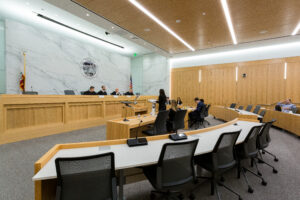
Long before graduation, UC Law SF students are drafting legislation, arguing appeals, advising companies, serving communities, and representing clients. Here are five ways they’re gaining real-world experience before they enter the profession.
1. Helping Shape State Legislation
 UC Law SF students can pursue one of 12 concentrations to tailor course-work to their intended practice areas. Related clinical opportunities provide real-world experience while still in school. Cayden Lumbad ’26 pursued the Government Law Concentration, and through the Legislation Clinic was placed in 2025-26 with the office of state Sen. Tom Umberg ’80. While there, Lumbad helped research and draft legislation related to veterans’ affairs, the judiciary, and labor. “Working on bills that would affect how local governments operate, and having those bills signed by the governor, was an incredibly rewarding experience,” he said.
2. Arguing Cases on Appeal
 Most lawyers never handle an appellate case. But each year, UC Law SF Appellate Project students brief and argue matters before federal and state courts of appeal. In 2025-26 William Kunkle ’26 was one of three students to do so, handling a criminal case before California’s First Appellate District. “I am the first in my family to attend law school, so being able to tell my mom and brothers that an argument written by me would be considered by a panel of judges was a surreal milestone,” Kunkle said. Through the project, Kunkle worked closely with appellate practitioners, met jurists, and obtained a position at an appellate firm. “The Appellate Project has built the foundation for the career I want in appellate practice,” he said.
3. Learning the Business of Law
 The best way to understand in-house practice is to do it, and that’s an opportunity the UC Law SF Corporate Counsel Externship Program offers. Each year about 40 students enroll in a seminar focused on corporate practice while working up to 20 hours a week with in-house attorneys at major companies.
Isabel Samayoa ’26, who plans to go into corporate and transactional law, joined the Airbnb corporate counsel’s office in 2026.
“I supported the Airbnb legal team across several functions, including commercial contracts, open-source licensing matters, strategic external partnerships, legal research, real estate matters, internal AI integration, and product counseling,” said Samayoa, adding that Airbnb counsel made her feel welcome. “I learned how lawyers can provide valuable advice to support business goals, seeing how leadership evaluates risk and develops growth strategies.”
Katrina Simons ’26 externed at Delicato Family Wines.
“I contributed to projects involving international law, intellectual property, marketing, litigation, environmental sustainability, and regulatory compliance,” she said. “I also toured several Delicato facilities across Napa,
Manteca, and Geyserville, including recycling plants, bottling facilities, and consumer-facing locations.”
The hands-on opportunities “opened my eyes to a potential career path,” she continued. “I saw how multifaceted in-house legal departments are and how attorneys manage a wide range of issues while working closely with business teams.”
4. Serving the Public Interest
 UC Law SF students are increasingly trading their spring break getaways for mini-externships in places including Mexico City, Detroit, St. Louis, and up and down the state of California. Through the Alternative Spring Break program, students — including those who might find it hard to squeeze pro bono hours or career explorations into their schedules — are supporting legal aid offices, government agencies, and nonprofits advocating for seniors, affordable housing, and more. In 2025-26, the program saw student applicants double to 160 and placements grow from roughly 70 to 115. Students served 22 organizations in 14 cities.
Lauren Tankeh, a 2L who has a master’s degree in education policy and intends to work in the field, analyzed state legislation for the Alameda County Office of Education, advising on potential impacts and positions on bills. “It is important to have legislative and policy work in my wheelhouse,” said Tankeh. “So much of 1L is theoretical and abstract. Taking a week to do hands-on work can ground you and remind you why you are in law school.”
5. Advocating for Immigrant Clients
 Venturing into the heart of the U.S. immigration system in a time of stepped-up immigration enforcement, 11 students took part in the new in-house track of UC Law SF’s Immigrants’ Rights Clinic in 2025-26. Students visited ICE detention centers, conducted interviews with detainees, and drafted habeas corpus petitions under the guidance of Professors Jonathan Abel and Richard Boswell, who argued the cases in federal court. The clinic handled 17 cases across four federal districts, helping to secure release from custody of 15 individuals who had been improperly detained. Juan Herrera ’26, who participated in the clinic in Fall 2025, said that working with clients and their families was deeply moving and that the effort helped prepare him for practice. “Being in the courtroom taught me how to read and interact with opposing counsel, when to be assertive, and how composure can shape outcomes,” he said. “I am a better law student — and a better person — because of this experience.”