A Legacy Built for the Future
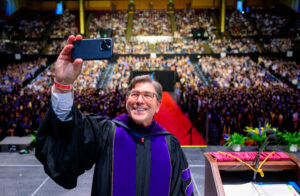
As Chancellor & Dean David Faigman’s tenure enters its final chapter, his influence is felt not just in what’s been built, but in how the College is positioned for what comes next.
Standing on stage at the Bill Graham Civic Auditorium, Chancellor & Dean David Faigman looks out at the faces of hundreds of law students preparing to graduate from the institution he’s called home for nearly 40 years.
Shaking hands with more than 350 graduates, he senses the pride in their accomplishment — and in a school that, under his leadership since 2016, has been transformed: new buildings and academic partners, sweeping curriculum reforms, cutting-edge centers focused on emerging areas of law, a push to grow private
donor support, and — after 144 years — a new name.
“David’s tenure is a sprint,” said Assistant Chancellor & Dean Jenny Kwon. “It isn’t ‘status quo: let’s do what we’ve always done.’ It’s ‘How can we be better? Let’s take calculated risks to be excellent.’”
As he approaches the end of his leadership tenure in June 2027, Faigman reflects on his work over the last decade and how California’s first law school can continue to shape an evolving legal profession into the future.
“A transformation in the practice of law and legal education is already underway,” he said. “I hope I’ve positioned the institution to help define what that change looks like.”
A Law School Transformed
When Faigman became interim chancellor & dean in 2016, the College faced significant challenges. Bar passage rates had fallen sharply. Law schools nationally were under financial pressure, and technology was beginning to reshape the legal profession.
Faigman pushed the College to think more broadly about its future — not just as a traditional law school, but as an interdisciplinary academic hub connected to fields like technology, health care, business, and science.
Over the last decade, that vision has shaped the College’s growth.
Under his leadership, the school launched centers and programs focused on artificial intelligence and innovation, indigenous law, constitutional democracy, and more. New courses and concentrations were added to prepare students for a fast-changing profession.
The College also expanded experiential learning opportunities, adding clinics focused on immigration detention, low-income taxpayers, and in-house corporate practice.
Prioritizing Student Success
Improving bar passage outcomes on two fronts became one of Faigman’s most pressing early priorities.
In his first year as dean, 51% of the College’s graduates passed the California bar exam on their first try, well below historical norms. Faigman backed a sweeping overhaul of academic support and bar preparation led by Provost & Academic Dean Morris Ratner. The College expanded bar-tested coursework, increased skills instruction, and added new support programs grounded in data about student success.
As a result, first-time bar passage rates climbed to 86%, while total employment for first-year graduates rose from 85% to 96%.
“We could not have achieved the unprecedented turnaround on bar success without Dean Faigman’s strategic prioritization, willingness to devote resources, and thought partnership,” Ratner said.
Faigman also emerged as one of the state’s most outspoken voices for bar exam reform, arguing that California’s unusually high cut score placed unnecessary financial and emotional burdens on graduates forced to retake the exam. His campaign — waged through open letters and opinion pieces — contributed to California lowering the cut score in 2020.
“He’s fearless,” said Dean Emeritus Leo Martinez ’78. “He directly confronted the chief justice of the California Supreme Court about the cut score, and the result benefited not only UC Law but law students across the state.”
New Name, New Era
One of the most consequential periods of Faigman’s tenure came in the lead-up to passage of a state law that changed the College’s name from UC Hastings to UC Law San Francisco in 2023. The decision was spurred by historical research documenting founder Serranus Hastings’ role in the mass killings of Native Americans in the 1850s — a past the school and the State of California could not leave unaddressed.
The process was neither quick nor simple, involving difficult conversations with lawmakers, tribal leaders, alumni, students, and faculty. Faigman also championed restorative justice initiatives benefiting descendants of the affected Yuki people, including a scholarship for local high school graduates and formal partnerships with the Round Valley Indian Tribes.
“It was important to honor the memory of victims of past crimes, uplift their descendants, and build bridges where none existed before,” Faigman said.
A Stable Foundation
He also kept a steady focus on the institution’s long-term financial health.
When the College faced financial strain and some urged selling property, Faigman made the opposite bet — investing in new buildings at 198 McAllister St. and the Cotchett Law Center at 333 Golden Gate Ave. Those projects anchor the College’s Academic Village strategy: housing students and programs from UC Law SF and partner universities while generating revenue to help sustain the law school.
Today, the campus hosts students and academic programs from multiple institutions, reflecting Faigman’s broader effort to position the College as more than a stand-alone law school.
“David Faigman pushed forward long-overdue academic reforms and made smart use of our real estate to boost both our reputation and our financial stability,” said Chief Financial Officer David Seward.
From Scholar to Leader
Faigman’s connection to the College goes back to 1987, when he joined the faculty after what he describes as a chance encounter.
On his way to a faculty hiring conference in Chicago, Faigman struck up a conversation on an airport shuttle bus with a longtime friend of Professor John Diamond, who sat on the College’s hiring committee. Diamond reviewed Faigman’s résumé, arranged a last-minute interview, and ultimately helped bring him to UC Hastings as a young professor teaching property and evidence. “In a sense I feel responsible for bringing him here,” Diamond said. “He turned out to be a great faculty member and a great dean.”
Faigman arrived during the final years of the school’s famed “65 Club” era, which brought distinguished professors forced into retirement elsewhere to teach at UC Law SF. He credits scholars such as the late 65 Club member William B. Lockhart and the late Emerita Chancellor & Dean Mary Kay Kane with shaping his development as a professor and leader.
“They made me the professional that I am today,” he said.
Over the next three decades, Faigman built a national reputation at the intersection of law and science — authoring a five-volume treatise on scientific evidence, publishing three books and dozens of articles and essays in leading law journals, offering expert testimony in court, and being named the most-cited evidence scholar in the country.
His interest in interdisciplinary work also predates his deanship. In 2009, he became founding director of the Consortium on Law, Science and Health Policy, created in partnership with UC San Francisco. He also worked with Professor of Practice Sarah Hooper ’08, who now leads the consortium, to co-create the Medical-Legal Partnership for Seniors Clinic, where students work alongside health care providers to help low-income seniors navigate housing, benefits, and other legal challenges.
Despite his long career at the College, Faigman initially resisted taking the top job when the position opened at the end of 2015.
“I already had my dream job — a tenured position at a great law school,” he said.
What moved him was the persistence of the late James “Jim” Mahoney ’66, an emeritus UC Law SF board director, who kept pressing Faigman to apply — appealing to his sense of duty and loyalty to the institution.
Faigman had been planning a sabbatical to write a book on constitutional law. Instead, he stepped in as interim chancellor & dean in January 2016 and officially took on the role later that year, also at Mahoney’s urging.
“Jim believed in me,” Faigman said, adding that he looks forward to finishing that book he started when his deanship ends next year.
Investing in the Future
Strengthening the College financially has been one of Faigman’s most consistent and consequential priorities.
The results speak for themselves: Since 2016, average annual giving has more than doubled compared with the previous decade. Donors established 58 new scholarship funds, including 30 endowed funds.
Last year, the College publicly launched its first-ever comprehensive fundraising campaign. The Into the Future campaign aims to raise $100 million to support student success, faculty excellence, innovative initiatives, and the Academic Village.
“To be a truly great law school, you need the resources to attract the best students, faculty, and staff,” Faigman said.
As he prepares to hand over the reins, Faigman said he hopes he will be remembered for continuing the tradition of reinvention embraced by the College’s most influential deans — including David Snodgrass (1940-1963), who launched the 65 Club, and Dean Kane (1993-2006), who elevated the school by recruiting exceptional scholars.
“I think innovation is part of our DNA as a law school,” Faigman said.
There is no formula, he said, for making UC Law SF a top law school. It demands constant adaptation, a willingness to innovate, and an eye always fixed on what’s coming next.
“It’s about leaving a foundation for opportunity,” Faigman said. “Our success into the future depends on the entire community.”