Welcome to the law school’s master calendar! Use the “Event Category” filter below to find events by intended audience. (For example, if you are an alum, click on the Event Category button below and select “Alumni” from the drop-down menu; the calendar will then display events open to alumni). Please note that this is a public-facing calendar that contains all events happening on campus, any details that you wish to remain private to the UC Law SF community should not be included in your event submission. Changes to your event submissions may be directed to: website@uclawsf.edu.

- This event has passed.
Symposium: The Rule of Law and Threats to Democracy
November 14, 2025 @ 9:00 am - 5:00 pm
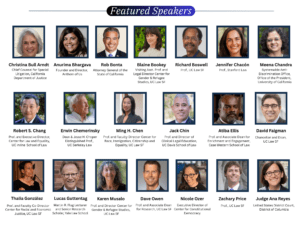
The Center for Racial and Economic Justice, Center for Gender and Refugee Studies, Center for Race, Immigration, and Citizenship, and Center for Constitutional Democracy invite you to attend The Rule of Law and Threats to Democracy. Featured speakers will address critical topics including threats to democracy and voting, challenges to higher education and attacks on “Diversity, Equity and Inclusion,” and the rights of non-citizens.
| Contents |
| Featured Speakers |
| Program Schedule |
| Speaker Biographies |
| RSVP for Event |
Program Schedule
| Time | Program |
|---|---|
| 8:30 am – 9:00 am |
Breakfast |
| 9:00 am – 9:30 am |
Reflections on the Moment: A Conversation between California Attorney General Rob Bonta and UC Law SF Chancellor and Dean David Faigman Introduction: Blaine Bookey, Visiting Assistant Professor and Legal Director, Center for Gender and Refugee Studies, UC Law SF Speakers: Rob Bonta, Attorney General of California and David Faigman, Chancellor and Dean, UC Law SF |
| 9:30 am – 10:45 am |
Panel #1 Rule of Law and Threats to Democracy Panelists:
Moderator:
|
| 10:45 am – 11:00 am |
Break |
| 11:00 am – 12:15 pm |
Panel #2 Rule of Law, “Diversity, Equity and Inclusion,” and Higher Education Panelists:
Moderator:
|
| 12:15 pm – 12:30 pm |
Lunch Break |
| 12:30 pm – 1:30 pm |
Matthew O. Tobriner Lecture Introduction: Dave Owen, Professor and Associate Dean for Research, UC Law SF Speaker: Erwin Chemerinsky, Dean & Jesse H. Choper Distinguished Professor of Law of UC Berkeley Law |
| 1:30 pm – 1:45 pm |
Break |
| 1:45 pm – 3:00 pm |
Panel #3 Rule of Law: The Constitutional and Statutory Rights of Non-Citizens Panelists:
Moderator:
|
| 3:00 pm – 3:15 pm |
Closing Remarks Speaker: David Faigman, Chancellor and Dean, UC Law SF |
| 3:15 pm – 3:30 pm |
Break |
| 3:30 pm – 5:00 pm |
Reception Welcome: Nicole Ozer, Executive Director, Center for Constitutional Democracy Join us for an afternoon reception to close our symposium day together and welcome the new Center for Constitutional Democracy. Hosted by the Chancellor & Dean’s Office. |
Speaker Biographies
Christina Bull Arndt

Bio:
Christina Bull Arndt is the Chief Counsel for Special Litigation at the California Department of Justice, where she oversees California’s response to the federal administration’s unlawful actions. As Chief Counsel she is responsible for facilitating internal communication and working with multistate partners and external stakeholders. In the last ten months California has filed nearly 50 lawsuits addressing matters including federal funding cuts, agency dismantling, data disclosure demands, and National Guard deployment. Those actions have been broadly successful, including saving California over $168 billion in funding for education, healthcare, and infrastructure; protecting Californians’ sensitive data; preserving access to public benefits like healthcare, disability, and nutrition programs; and protecting birthright citizenship.
Christina has practiced in the California Department of Justice for 25 years. Prior to her current position, Christina was a Supervising Deputy Attorney General in the Land Use and Conservation Section where she represented state agencies that own and regulate land in California, including the California Coastal Commission and the Santa Monica Mountains Conservancy. There, she led the Department’s Housing Justice Team which enforces California’s housing laws to increase housing affordability and access across the state. She also led the cross-sectional team addressing land use and wildfire risk. Christina previously administered the Honors Program which provides new lawyers the opportunity to join the Department. Christina also worked in the Office of the Solicitor General on federal and state appellate matters. She started her practice in the Department in the Civil Division in the Torts and Condemnation Section, where she was responsible for trial and appellate litigation in state and federal court. Christina worked in private practice before joining the Office of the Attorney General. Before law school, Christina was a logistics specialist for the U.S. Navy. Christina graduated from Mount Holyoke College and UCLA Law School.
Anurima Bhargava

Bio:
Anurima Bhargava is the Founder andCEO of Anthem of Us, a strategic advisory and consulting firm that centers dignity, justice, and belonging in workplaces, schools, and communities. Clients include leading financial institutions, corporations, foundations, schools, and media, arts, and non-profit organizations.
From 2018-2022, she served as Chair and Commissioner of the U.S. Commission on International Religious Freedom, which documents and makes recommendations on religious persecution and violence abroad. She made diplomatic visits to Burma, the Rohingya camps in Bangladesh, Iraq, Sudan, and Vietnam. Her engagement across the Commission was recently profiled in the New York Times.
From 2010-2016, Bhargava led federal civil rights enforcement and policy in schools and higher education institutions across the nation at the U.S. Department of Justice; she spearheaded landmark guidance and litigation on school discipline, sexual harassment and violence, English Learners, and students with disabilities. She previously served as Director of the Education Practice and associate counsel at the NAACP Legal Defense Fund from 2004-2010, where she litigated cases on diversity, discrimination and segregation in schools and higher education institutions, including in the federal appellate courts and U.S. Supreme Court. From 2016-2018, she was a fellow at the Institute of Politics and the Carr Center for Human Rights at Harvard, and a Leadership in Government Fellow at Open Society Foundations.
A central pillar of Anthem of Us’s work is advancing dignity and justice through narrative and storytelling. Bhargava has produced and advised numerous documentary films and projects, including the Oscar-nominated and Peabody-winning documentary, Writing With Fire, Peabody-winning While We Watched; Emmy-nominated Our Body Politic, A Shot At History, The Inquisitor, Barefoot Empress, Patang and the HBO docuseries The Vow. She recently premiered her directorial debut, Teaching America, which chronicles the students and teachers who joined together to stand up for African-American Studies classes in Arkansas.
Bhargava chairs the U.S. Board of Doc Society; co-chairs the National Advisory Board on Public Service at Harvard; and serves on the board of the National Women’s Law Center Action Fund and Democracy House. She serves on the Capacity Council for Brown Girls Doc Mafia and the leadership committee of Crimson Courage.
Bhargava advises numerous political campaigns and was appointed to the 2020 DNC Platform Committee. She co-founded a multi-racial PAC, Anthem of America, and is an advisor to South Asians for America. She is a 2017 Presidential Leadership Scholar. Bhargava graduated magna cum laude from Harvard College, and was elected Chief Marshal of her Harvard class. She earned her law degree from Columbia Law School. She was born and raised on the south side of Chicago, and is a graduate of Kenwood Academy.
Rob Bonta

Bio:
On April 23, 2021, Rob Bonta was sworn in as the 34th Attorney General of the State of California, the first person of Filipino descent and the second Asian-American to occupy the position.
Attorney General Bonta’s passion for justice and fairness was instilled in him by his parents, who served on the frontlines of some of America’s most important social justice movements. Instilling in him the lessons they learned from the United Farm Workers and the civil rights movement, Attorney General Bonta’s parents lit a fire inside him to fight against injustice — to stand up for those who are taken advantage of or harmed. It’s why he decided to become a lawyer — to help right historic wrongs and fight for people who have been harmed. He worked his way through college and graduated with honors from Yale University and attended Yale Law School.
In the State Assembly, Attorney General Bonta enacted nation-leading reforms to inject more justice and fairness into government and institutions. As the People’s Attorney, he sees seeking accountability from those who abuse their power and harm others as one of the most important functions of the job. In elected office, he has taken on powerful interests and advanced systemic change — pursuing corporate accountability, standing up for workers, punishing big polluters, and fighting racial injustice. He has been a national leader in the fight to transform the criminal justice system, banning private prisons and detention facilities in California, as well as pushing to eliminate cash bail in the state. He has led statewide fights for racial, economic, and environmental justice and worked to further the rights of immigrant families, renters, and working Californians.
Prior to serving in the Assembly, Attorney General Bonta worked as a Deputy City Attorney for the City and County of San Francisco, where he represented the City and County and its employees, and fought to protect Californians from exploitation and racial profiling.
Born in Quezon City, Philippines, Attorney General Bonta immigrated to California with his family as an infant. He is the son of a proud native Filipino mother and a father who taught him the value of public service to his community. He is married to Mia Bonta, and they are the proud parents of three children Reina, Iliana, and Andres.
Blaine Bookey

Bio:
Blaine oversees strategic litigation, policy and advocacy, and research on behalf of refugees and asylum seekers, as well as provision of technical assistance and training to attorneys across the country. Blaine also teaches courses in human rights at UC Law SF.
Prior to joining CGRS, Blaine served as a law clerk to the Honorable Dolores K. Sloviter of the Third Circuit and as a fellow with the Bureau des Avocats Internationaux in Port au Prince, Haiti. Before law school, she worked as an immigration paralegal for several years.
Richard Boswell

Bio:
Professor Boswell joined the full-time faculty at UC Law SF after teaching as a visiting professor in 1990. He received his B.A. in Urban Economics from Loyola-Marymount University in Los Angeles and his J.D. from the George Washington University National Law Center where he was a member of the Journal of International Law & Economics. He was in private practice and later joined the faculty of the George Washington University National Law Center where he founded the law school’s immigration clinic and directed their Trial Practice Program. Working his way west, he joined the law faculty at the Notre Dame in 1986.
Professor Boswell has written extensively in the field of immigration law and is the author of more than 11 books and more than 17 articles. His major books include Immigration Law & Procedure: Cases and Materials (5th ed. 2018), Refugee Law & Policy: a Comparative and International Approach (5th Ed. 2018) (coauthored with Karen Musalo and Jennifer Moore) and Essentials of Immigration Law (5th ed. 2020). He has testified on numerous occasions before congressional committees and is a frequent lecturer on immigration law both nationally and internationally. Most recently he has served as Special Master for the U.S. District Court for the Eastern District of California in Catholic Social Services, et al. v. Napolitano, a class action involving the 1986 immigration amnesty.
As one of the founders of the Clinical Education Association, he served as its President in 1994. He served as coeditor-in-chief of the Clinical Law Review for 5 years (1997-2002) and remains as an ex-officio member of its Board of Editors. The Clinical Law Review is a peer reviewed law journal of the Clinical Legal Education Association (CLEA), the New York University Law School and the Association of American Law Schools (AALS). In addition to his work in clinical legal education, Professor Boswell has worked on rule of law/justice projects in Central Asia, Colombia, Guatemala, Honduras, Palestine, Panama and Venezuela and most recently in Haiti. His current scholarly work involves a comparative study of the immigration laws of more than seven countries covering a broad range of legal systems.
Jennifer Chacón

Bio:
Jennifer M. Chacón researches issues that arise at the nexus of immigration law, constitutional law, and criminal law and procedure. Her writings elucidate how legal frameworks on immigration and law enforcement shape individual and collective understandings of racial and ethnic identity, citizenship, civic engagement, and social belonging. She is the co-author of the immigration law textbook Immigration Law and Social Justice, now in its second edition, and the co-author of Legal Phantoms (Stanford University Press, 2024), which explores how the past decade’s shifting immigration policies have shaped, and been shaped by, immigrant communities and organizations in Southern California. She has written dozens of articles, book chapters, and essays on immigration, criminal law, constitutional law, and citizenship issues. Her research has been funded by the Russell Sage Foundation, the National Science Foundation, and the University of California.
Professor Chacón is a past Chair of the American Association of Law School’s Section on Immigration, and of the Ninth Circuit Court of Appeals Rules Committee. She is a member of the American Law Institute, and is a Fellow of the American Bar Foundation (ABF). She is a member of the ABF’s Fellows Research Advisory Committee and the Latina Lawyers Bar Association Advisory Board. She has also served on the Advisory Committee of the ABF’s “Future of Latinos in the U.S.” project, the ABF’s Board of Directors, and the University of Oxford Border Criminologies Advisory Group. She was a co-convenor of the Immigration Policy Advisory Committee to then-Senator Barack Obama during his 2008 presidential campaign, and an outside advisor to the Immigration Transition Team of President-Elect Barack Obama from November 2008 through January 2009.
Professor Chacόn was an associate at the New York law firm of Davis Polk and Wardwell after clerking for the Honorable Sidney R. Thomas of the Ninth Circuit (1998-1999). She has also held appointments as a Professor of Law at the University of California, Berkeley, School of Law, the UCLA School of Law, and the UC Davis King Hall School of Law, and as a Chancellor’s Professor of Law and Senior Associate Dean for Administration at the University of California, Irvine, School of Law. She was a Visiting Professor of Law at Stanford Law School (2015-2016) and Harvard Law School (2014-2015). She received the Distinguished Teaching Award at the UC Davis King Hall School of Law (2009), a student-sponsored teaching award at Harvard Law School (2014), and the Professor of the Year award at UCLA School of Law (2021). She holds a J.D. from Yale Law School and an A.B. in International Relations from Stanford University.
Meena Chandra

Bio:
Meena Morey Chandra joined the University of California, Office of the President as its inaugural Systemwide Anti-Discrimination Director on May 5th, 2025. A key member of the Systemwide Office of Civil Rights (SOCR), she provides education, investigation and resolution guidance, and strategic support related to UC’s Anti-Discrimination Policy to UC’s 10 campuses, six academic health centers, and the Lawrence Berkeley National Laboratory.
Prior to joining UC, Ms. Morey Chandra served an enforcement director at the U.S. Department of Education, Office for Civil Rights (OCR). A member of the Senior Executive Service, Ms. Morey Chandra oversaw the three regional offices in the Central Time zone: Chicago, Kansas City, and Dallas. Responsible for overseeing federal civil-rights law enforcement for 15 states, she led about 125 employees. During her nearly twenty-seven years with OCR, Ms. Morey Chandra held nearly every position in the agency on the enforcement side—starting as a staff attorney, then team leader, program manager, regional director for OCR Cleveland overseeing two states, (Ohio and Michigan), and finally as enforcement director, overseeing three regional offices. Ms. Morey Chandra has investigated, negotiated, and supervised thousands of OCR cases—and has deep expertise in Title VI, Title IX, Section 504 of Rehabilitation Act, and Title II of the Americans with Disabilities Act. Some of the matters on which she worked were high-profile, groundbreaking, and sensitive matters in OCR requiring coordination with other department agencies, the U.S. Department of Justice, and local law enforcement. She also led a team that revised OCR’s case processing manual used to process thousands of cases annually.
Before joining OCR, Ms. Morey Chandra was in private practice where she worked as a litigator at a plaintiffs’ boutique law firm, mostly on large class-action cases. Ms. Morey Chandra earned a bachelor’s degree in Philosophy from Cleveland State University and her juris doctorate from Cleveland State University College of Law.
Robert S. Chang

Bio:
Professor Robert S. Chang joins UC Irvine School of Law as the executive director of the UC Irvine School of Law Fred T. Korematsu Center for Law and Equality. Professor Chang is the inaugural chair holder of the Sylvia Mendez Presidential Chair for Civil Rights.
Prof. Chang founded the center — named for pioneering civil rights hero Fred T. Korematsu — in 2009 at the Seattle University School of Law. The center leads numerous initiatives and projects focused on research, advocacy, and clinical education. Learn more about Prof. Chang and the Korematsu Center’s move to its new home in Irvine.
Prof. Chang is one of the nation’s leading scholars on issues of race and interethnic relations, and one of the most recognized voices on Asian Americans and the law. He is the author of “Disoriented: Asian Americans, Law and the Nation-State” (NYU Press 1999) and co-editor of “Minority Relations: Intergroup Conflict and Cooperation” (University Press of Mississippi 2017). His most recent book, “Banned: The Fight for Mexican American Studies in the Streets and in the Courts” (with Nolan Cabrera), was published at the beginning of this year by Cambridge University Press. He has another book forthcoming later this year, as well as book, “AsianCrit at the Intersections” (with Rose Cuison Villazor), under contract with University of California Press that will be published in 2027. He has authored more than 60 articles, essays and chapters published in leading law reviews and books on minority relations, critical race theory, LatCrit theory and Asian American legal studies.
An elected member of the American Law Institute, Prof. Chang has received numerous recognitions for his scholarship and service. In 2024, several local, state, and national bar associations conferred awards, including the 2024 Daniel K. Inouye Trailblazer Award, the lifetime achievement award of the National Asian Pacific American Bar Association. Among other awards, Prof. Chang is the 2022 recipient of Seattle University’s McGoldrick Fellowship, the most prestigious honor Seattle University confers upon its faculty; the 2021 co-recipient of the Kathleen Taylor Civil Libertarian Award from ACLU-Washington; the 2018 recipient of the M. Shanara Gilbert Human Rights Award from The Society of American Law Teachers; the 2014 co-recipient of the Charles A. Goldmark Distinguished Service Award from the Legal Foundation of Washington; and the 2009 co-recipient of the Clyde Ferguson Award from the Minority Groups Section of the Association of American Law Schools.
Prior to joining UC Irvine School of Law, Prof. Chang held professorships at Seattle University School of Law and Loyola Law School in Los Angeles. Prof. Chang received an A.B. from Princeton University and holds M.A. and J.D. degrees from Duke University.
Erwin Chemerinsky

Bio:
Erwin Chemerinsky became the 13th Dean of Berkeley Law on July 1, 2017, when he joined the faculty as the Jesse H. Choper Distinguished Professor of Law.
Prior to assuming this position, from 2008-2017, he was the founding Dean and Distinguished Professor of Law, and Raymond Pryke Professor of First Amendment Law, at University of California, Irvine School of Law. Before that he was the Alston and Bird Professor of Law and Political Science at Duke University from 2004-2008, and from 1983-2004 was a professor at the University of Southern California Law School, including as the Sydney M. Irmas Professor of Public Interest Law, Legal Ethics, and Political Science. From 1980-1983, he was an assistant professor at DePaul College of Law.
He is the author of nineteen books, including leading casebooks and treatises about constitutional law, criminal procedure, and federal jurisdiction. His most recent major books are Worse than Nothing: The Dangerous Fallacy of Originalism (2022) and Presumed Guilty: How the Supreme Court Empowered the Police and Subverted Civil Rights (2021).
He also is the author of more than 200 law review articles. He is a contributing writer for the Opinion section of the Los Angeles Times, and writes regular columns for the Sacramento Bee, the ABA Journal and the Daily Journal, and frequent op-eds in newspapers across the country. He frequently argues appellate cases, including in the United States Supreme Court.
In 2016, he was named a fellow of the American Academy of Arts and Sciences. In 2024, National Jurist magazine again named Dean Chemerinsky as the most influential person in legal education in the United States. In 2022, he was the President of the Association of American Law Schools. He received his B.S. at Northwestern University and his J.D. at Harvard Law School.
Ming H. Chen

Bio:
Ming Hsu Chen is a Professor of Law and Faculty-Director of the Race, Immigration, Citizenship, and Equality Program. She teaches courses in Constitutional Law, Legislation and Administrative Regulation, Citizenship, and Immigration. Professor Chen brings an interdisciplinary perspective to the study of race, immigration, and the administrative state. Her scholarship is published in leading law reviews and social science journals. She is author of Pursuing Citizenship in the Enforcement Era (Stanford University Press 2020), on which she gave a TEDx Talk in 2020. She serves as Co-Editor for the Immigration Prof blog (@immprof) and the executive committee for the AALS Immigration Section and the Law and Society Association’s Citizenship and Migration Section.
Professor Chen was previously a professor of law, political science, and ethnic studies at the University of Colorado Boulder where she founded the Immigration and Citizenship Law Program. She has served on the Colorado state advisory council to the U.S. Commission on Civil Rights. Prior to joining the legal academy, Professor Chen clerked for the Honorable James R. Browning on the U.S. Court of Appeals, Ninth Circuit in San Francisco and earned degrees from the University of California Berkeley (Ph.D 2011), New York University Law School (JD 2004), and Harvard College (AB 2000).
Jack Chin

Bio:
Gabriel “Jack” Chin is a teacher and scholar of Immigration Law, Criminal Procedure, and Race and Law. His scholarship has appeared in the Penn, UCLA, Cornell, and Harvard Civil Rights-Civil Liberties law reviews and the Yale, Duke and Georgetown law journals, among others. The U.S. Supreme Court cited his work on collateral consequences of criminal conviction in Chaidez v. United States, 133 S. Ct. 1103, 1109 (2013), in which the Court called his Cornell Law Review article “the principal scholarly article on the subject” and in Padilla v. Kentucky, 130 S. Ct. 1473 (2010), which agreed with his contention that the Sixth Amendment required defense counsel to advise clients about potential deportation consequences of guilty pleas. Justice Sotomayor cited his Penn Law Review article in her dissent in Utah v. Strieff, 136 S. Ct. 2056, 2070 (2016).
He teaches Criminal Law, Criminal Procedure, and Immigration, and is Director of Clinical Legal Education. He also works with students on professional projects. His efforts with students to repeal Jim Crow laws still on the books include a successful 2003 petition to the Ohio legislature to ratify the Fourteenth Amendment, 136 years after the state disapproved it during the ratification process. He and his students also achieved the repeal of anti-Asian alien land laws, which were on the books in Kansas, New Mexico and Wyoming. For this work, ” A” Magazine named him one of the “25 Most Notable Asians in America.” In connection with classes with a practical component, he has tried felony cases and argued criminal appeals with his students.
Professor Chin earned a B.A. at Wesleyan, a J.D. from Michigan and an LL.M. from Yale. He clerked for U.S. District Judge Richard P. Matsch in Denver and practiced with Skadden, Arps, Slate, Meagher & Flom and The Legal Aid Society of New York. He taught at the Arizona, Cincinnati, NYU and Western New England law schools before joining the UC Davis faculty. His professional activities include service as Reporter on the Uniform Collateral Consequences of Conviction Act, approved in 2009 by the Uniform Law Commission, and for the ABA Standards for Criminal Justice: Collateral Sanctions and Discretionary Disqualification of Convicted Persons (3d ed. 2003). Chin is a founding board member of the Collateral Consequences Resource Center and a member of the American Law Institute.
Atiba Ellis

Bio:
Atiba R. Ellis is the Laura B. Chisolm Distinguished Research Scholar, Associate Dean for Enrichment and Engagement, and Professor of Law at Case Western Reserve University School of Law. A nationally noted voting rights scholar, his primary research focuses on how racial and class-based oppression interact continues to abridge and deny the right to vote to communities on the margins of American democracy. His work has analyzed voter identification laws for their socioeconomic effects, situated felon disenfranchisement laws as enforcing a political underclass, analyzed the theoretical scope of the Citizens United decision and described the ideological drivers of vote suppression. His work is interdisciplinary in nature, spanning doctrinal legal analysis, critical political theory, race and the law, legal history, and innovative legal pedagogy.
Professor Ellis’s current research focuses on how ideologically driven conceptions of “wrongful voters” diminish the right to vote. He has also written on critical legal theory and legal history. Moreover, he is currently working with his co-authors to publish a new edition of the late Derrick Bell’s foundational textbook, RACE RACISM AND AMERICAN LAW.
In addition to his scholarly research, Professor Ellis frequently blogs, presents academic lectures and provides commentary on issues regarding race and the law, the law of politics, and other civil rights and constitutional law matters.
Professor Ellis earned an A.B., an M.A., and a J.D. from Duke University. He served as a judicial law clerk for Judge James A. Beaty, Jr. of the U.S. District Court for the Middle District of North Carolina and Judge Theodore A. McKee of the U.S. Court of Appeals for the Third Circuit. He then practiced as a litigation associate at Akin Gump Straus Hauer and Feld in Washington, DC. He began his teaching career in 2006 at the Howard University School of Law, and then served at the West Virginia University College of Law from 2009-2018. Prior to joining the Case Western faculty, he served at Marquette Law faculty as a tenured professor from 2018-2022 and the Boden Visiting Professor of Law in the fall of 2017.
David Faigman

Bio:
Chancellor and Dean David Faigman is the William B. Lockhart Professor of Law and the John F. Digardi Distinguished Professor of Law at the University of California College of the Law, San Francisco and holds an appointment as Professor in the School of Medicine (Dept. of Psychiatry) at the University of California, San Francisco. He received both his M.A. (Psychology) and J.D. from the University of Virginia. Professor Faigman clerked for the Honorable Thomas M. Reavleyof the U.S. Court of Appeals for the Fifth Circuit.
He is the author of over 60 articles and essays, and has published in a variety of outlets, including the Chicago, Virginia, Pennsylvania and Northwestern law reviews, Science, PNAS, Sociological Methods & Research and Nature Reviews Neuroscience. He is also the author of three books, Constitutional Fictions: A Unified Theory of Constitutional Facts (Oxford, 2008), Laboratory of Justice: The Supreme Court’s 200-Year Struggle to Integrate Science and the Law (Henry Holt & Co. 2004) and Legal Alchemy: The Use and Misuse of Science in the Law (W.H. Freeman,1999). In addition, Professor Faigman is a co-author/co-editor of the five-volume treatise Modern Scientific Evidence: The Law and Science of Expert Testimony (with Cheng, Murphy, Saks, Sanders & Slobogin). The treatise has been cited widely by courts, including several times by the U.S. Supreme Court. Professor Faigman was a member of the National Academies of Science panel that investigated the scientific validity of polygraphs, a member of the MacArthur Law and Neuroscience Network and served as a Senior Advisor to the President’s Council of Advisors on Science and Technology’s Report, “Forensic Science in Criminal Courts: Ensuring Scientific Validity of Feature-Comparison Methods.”
Thalia González

Bio:
Thalia González is a Professor of Law and holds the James Edgar Hervey ’50 Chair of Litigation. Professor González is faculty co-director of the Center for Racial and Economic Justice, Senior Scholar in the UCSF/UC Law SF Consortium on Law, Science & Health Policy, and a faculty affiliate with the Center on Race, Immigration, Citizenship, and Equality, and Center for Social Justice.
Professor González is nationally recognized scholar whose research in restorative justice, education law, health justice, juvenile justice, critical race theory, and adultification bias has been published in leading academic journals including Boston College Law Review, American University Law Review, Wisconsin Law Review, Utah Law Review, Journal of Criminal Law and Criminology, Fordham Urban Law Journal, Stanford Law Review Online, UCLA Law Review Discourse, Georgetown Journal of Law and Modern Critical Race Theory Perspectives, N.Y.U. Review of Law & Social Change, Journal of Law, Medicine and Ethics, Contemporary Justice Review, and Conflict Resolution Quarterly. Additionally, her applied research has appeared in The Washington Post, The Atlantic, The New York Times, NPR and she is cited extensively in multiple fields. Professor González has received grant funding from the Robert Wood Johnson Foundation, Grantmakers for Girls of Color, Annie E. Casey Foundation, Spencer Foundation, and Atlantic Philanthropies. In recognition of her significant contributions to the field of restorative justice, Professor González received the National Association of Community and Restorative Justice Research Award in 2022.
Presently, Professor González serves as Co-Chair, ABA Criminal Justice Section, Diversion & Restorative Justice Committee, Vice Chair, Board of Directors, Public Health Advocates, and Chair, Board of Directors, National Association of Community and Restorative Justice. Since 2017, she has held an appointment as a Senior Scholar in the Center on Gender Justice and Opportunity at Georgetown Law and was previously a scholar in residence at Berkeley Law and UCLA School of Law. Prior to joining the faculty at UC Law SF, Professor González was the Madeline N. McKinnie Professor of Politics at Occidental College.
Lucas Guttentag

Bio:
Lucas Guttentag is a Martin R. Flug Lecturer in Law and senior research scholar in law at Yale Law School and professor of the practice of law at Stanford Law School. His career has spanned litigation, advocacy, academia, and government service. Guttentag founded the American Civil Liberties Union’s (ACLU) Immigrants’ Rights Project (IRP) and led it for 25 years until 2010, establishing it as the country’s premiere immigrant justice litigation organization and successfully arguing major cases in the United States Supreme Court and many trial and appellate courts nationwide. Guttentag held senior policy positions in the Biden administration Department of Justice and the Obama administration Department of Homeland Security, has testified before Congress, speaks and writes widely on immigration issues, and is regularly cited in the national media.
In 2017, he created the Immigration Policy Tracking Project, a dynamic website profiled in The New Yorker and The New York Times that documents every Trump administration immigration policy. Guttentag has been honored by many national and community-based organizations for his work and leadership, including being named the inaugural Human Rights Hero by the ABA Human Rights Journal, recognized as appellate lawyer of the year by California Lawyer magazine, named litigator of the year by the American Immigration Lawyers Association four times, and listed among the 500 Leading Lawyers in America by Lawdragon.
He was awarded an honorary degree by CUNY Law School and is an elected member of the American Law Institute (ALI). Guttentag earned his B.A. from the University of California at Berkeley and his J.D. from Harvard Law School, and served as law clerk to federal judge William Wayne Justice in Texas.
Karen Musalo

Bio:
Karen Musalo is the Bank of America Foundation Chair in International Law at the University of California College of the Law, San Francisco. She is the founding director of both the Refugee and Human Rights Clinic and the Center for Gender and Refugee Studies, which is internationally recognized for its research, legal advocacy, and expert consultation to attorneys worldwide.
Professor Musalo is the lead co-author of Refugee Law and Policy: An International and Comparative Approach (6th ed.). She has written extensively on refugee law and has shaped the evolving jurisprudence of asylum not only through her scholarship, but also through her litigation. For more than three decades, beginning with Matter of Kasinga, establishing female genital cutting as a basis for asylum, she has played a central role in every major landmark case involving gender-based violence and the right to refugee protection. Professor Musalo has also been influential in developing the legal analysis of claims grounded in freedom of thought, conscience, and religion, with particular focus on conscientious objection as a basis for protection.
She is widely recognized for her innovative work on refugee representation. She was the first attorney to collaborate with psychologists in advocating for traumatized asylum seekers, and she edited the earliest practitioner’s handbook on cross-cultural issues and the impact of culture on credibility in the asylum process. A frequent media commentator, she is also the author of numerous opinion pieces.
Professor Musalo has received multiple national awards in recognition of her advocacy on behalf of refugees. These include the 2010 California Lawyer of the Year Award, the Daily Journal’s 2009 recognition as one of California’s “Top 100” lawyers, and the 2015 Federal Bar Association Immigration Section Lawyer of the Year Award. In 2012, she was awarded an Honorary Doctor of Humane Letters from Lehman College, the same year she received UC Law SF’s Rutter Award for Excellence in Teaching. She is a frequent speaker at conferences across the United States, Canada, Europe, and Latin America.
Dave Owen

Bio:
Professor Dave Owen teaches courses in environmental, water, land use, energy, and administrative law. His interest in the subject area began when he was about six years old and his parents denied him access to all television except for PBS wildlife specials. He then became inordinately interested in poachers. He went on to study geology in college, primarily because the labs were outside, and became an environmental consultant. During one hot summer day of hazardous waste site sampling, while sweating miserably in a Tyvek suit and inhaling aniline fumes, he decided graduate school sounded like a nice idea. So he became an environmental lawyer. He went to Berkeley Law, where he served as editor-in-chief of Ecology Law Quarterly and was selected for the Order of the Coif.
Professor Owen went on to clerk at federal district court and then work for a small law firm in San Francisco, where his practice focused primarily on water law. He worked on Colorado River allocation, Sacramento-San Joaquin Delta litigation, and federal state disputes over the proposed Yucca Mountain nuclear waste repository, among other matters. In 2007, he began teaching at the University of Maine School of Law. He joined the Hastings faculty in 2015.
His research focuses primarily on water resource management, and some recent projects have addressed roles of negotiation in environmental regulation, equity implications of a turn toward community-centered energy governance, groundwater-surface water interactions, taxation of water consumption, the roles of federal regional offices, stream protection under the Clean Water Act, and policies to expedite dam removals and hydropower upgrades. Five of his articles have been recognized by his peers as among the top environmental law articles of their respective years; another article has won the Morrison Prize as the top sustainability-law article of its year; and he has presented three articles at the Harvard-Stanford-Yale Junior Faculty Forum. He also contributes to the Environmental Law Prof Blog.
In his spare time, Professor Owen was once a passably competent ultimate frisbee player. Now he mostly runs on trails, a bit slower with each passing year. He lives in Albany with his wife Megan, a pediatric occupational therapist, his two children, and a dog named Allie.
Nicole Ozer

Bio:
Nicole Ozer is a national leader in cutting-edge law and policy to advance rights, justice, and democracy and a legal expert on artificial intelligence, privacy and surveillance, and digital speech. Ozer’s innovative work in the courts, in communities, with companies, and policymakers passes landmark laws, wins civil rights cases, and builds power for national and international change.
Ozer spearheaded the passage of the California Electronic Communications Privacy Act (CalECPA) and California Reader Privacy Act. She designed groundbreaking surveillance reform strategies now used across the United States and created and led the national online privacy campaign, Demand Your dotRights. She helped craft the Santa Clara Principles on content moderation and develop and lead a global coalition successfully fighting face surveillance. She is frequently called upon for expert testimony, keynote presentations, and commentary in the press, including The New York Times, Washington Post, Univision, AP, BBC, NPR, PBS, Today Show, Good Morning America, Bloomberg, and The Wall Street Journal.
Prior to becoming the Executive Director of the Center for Constitutional Democracy at UC Law San Francisco, Ozer was the founding Director of the Technology and Civil Liberties Program at the ACLU of Northern California and developed and led the ACLU’s statewide work in California to defend and promote rights in the modern digital world for more than 20 years. Ozer was also a Technology and Human Rights Fellow at the Harvard Kennedy School, a Fellow at the Stanford Digital Civil Society Lab, a Visiting Researcher at the Berkeley Center for Law and Technology, and an intellectual property attorney at Morrison & Foerster LLP in San Francisco.
Ozer graduated magna cum laude from Amherst College, studied comparative civil rights history at the University of Cape Town, South Africa, and earned her J.D. with a Certificate in Law and Technology from Berkeley Law.
Honors
Ozer has been honored with the Fearless Advocate Award by the American Constitution Society, the Privacy Award by the Berkeley Center for Law & Technology, and the James Madison Freedom of Information Award by the Society of Professional Journalists. Ozer has been recognized as a top Artificial Intelligence Lawyer by the Daily Journal, twice recognized as a Woman Leader in Tech Law by the California Legal Awards, and San Jose Magazine selected her as one of 20 “Women Making a Mark” in Silicon Valley. Ozer was also honored in 2025 with a California Senate Members Resolution for unwavering dedication to defending and promoting civil liberties in the digital world, invaluable contributions to people throughout California, and meritorious service to humanity.
Service
Ozer is a member of the Artificial Intelligence Standing Committee of the California Lawyers Association, a Founding Board Member and current Advisory Board member of the Bay Area Lawyer Chapter of the American Constitution Society, and Vice President of the Berkeley Law Alumni Association. Ozer was also Co-President of her law school class and proudly served in the Summer of Service, the pilot program for the AmeriCorps National Service program.
Zachary Price

Bio:
Professor Zachary S. Price teaches and writes about constitutional law, administrative law, and criminal and civil law enforcement. His scholarly work focuses on constitutional questions generated by current political polarization.
Professor Price’s book Constitutional Symmetry: Judging in a Divided Republic was published by Cambridge University Press in November 2024. His scholarly articles include “Trumpian Impoundments in Historical Perspective” in the Stanford Law Review Online, “Appropriations Presidentialism” (written with Matthew Lawrence and Eloise Pasachoff) in the Georgetown Law Journal Online, “Faithful Execution in the Fifty States” in the Georgia Law Review, “Congress’s Power Over Military Offices” in the Texas Law Review, “Funding Restrictions and Separation of Powers” in the Vanderbilt Law Review, “Enforcement Discretion and Executive Duty” in the Vanderbilt Law Review, and “NAMUDNO’s Non-Existent Principle of State Equality” in the New York University Law Review Online. Professor Price has also contributed to publications including the Wall Street Journal, Washington Post, Scotusblog, Notice and Comment, Administrative and Regulatory News, Law and Liberty, Balkinization, the Supreme Court of California Blog, the State and Local Government Blog, and the Take Care Blog. In fall 2023, Professor Price was the Bruce Bromley Visiting Professor of Law at Harvard Law School.
Professor Price has taught at UC Law SF since 2013 and currently holds the Eucalyptus Foundation Endowed Chair. He joined UC Law SF following a fellowship at the Stanford Constitutional Law Center, and before entering academics, he served for three years as an attorney in the U.S. Justice Department’s Office of Legal Counsel. He has also worked as a litigator in private practice and clerked for Judge Catherine C. Blake of the U.S. District Court for the District of Maryland, Judge David S. Tatel of the U.S. Court of Appeals for the District of Columbia Circuit, and Justice Anthony M. Kennedy of the U.S. Supreme Court. He graduated from Harvard Law School magna cum laude and from Stanford University with honors and distinction. Between college and law school, he studied philosophy as a Fulbright Scholar at the University of Copenhagen and worked for a Member of Congress.
Judge Ana Reyes

Bio:
Judge Reyes was appointed as a United States District Judge in February of 2023, assuming the seat previously held by Judge Colleen Kollar-Kotelly.
Judge Reyes served as a law clerk to Judge Amalya L. Kearse on the U.S. Court of Appeals for the Second Circuit (2001). After clerking, Judge Reyes became a litigation attorney at Williams & Connolly LLP, where she spent her legal career from 2001 to 2023. While there, she served as the co-chair of the firm’s International Disputes practice group and on its Executive Committee. Her practice focused on international litigation, representing foreign governments, foreign government officials, and multinational companies. Judge Reyes also worked on patent, legal malpractice, and other complex civil litigation matters.
Judge Reyes devoted substantial pro bono time to assisting refugees and organizations that assist refugees in obtaining asylum, including the United Nations High Commissioner for Refugees and Human Rights First. In 2016, she received the Legacy Award from Unlikely Heroes for her successful representation of young women escaping persecution by a regional terrorist organization. The Legal Times has recognized her as a “Champion” for her pro bono efforts (2009).
In 2023, the Hispanic National Bar Foundation presented Judge Reyes with its “Judicial Leadership Award,” which recognizes excellence in the legal profession. While in private practice, Judge Reyes earned accolades from The Legal 500 as a “Leading Lawyer” (2023) and “Next Generation Lawyer” (2020-2022) in International Litigation and from Benchmark Litigation as a “Local Litigation Star” (2019-2023). The National Law Journal recognized her multiple times, including on its Outstanding Women Lawyers list recognizing “the 75 most accomplished female attorneys working in the legal profession today” (2015); as an “Immigration Trailblazer” (2018); a Washington D.C. “Rising Star” (2014); and as a Minority 40 Under 40 (2011). In 2017, the Women’s Bar Association of D.C. named her as its “Woman Lawyer of the Year.”
Judge Reyes was born in Montevideo, Uruguay, and grew up in Louisville, Kentucky. She received her J.D., magna cum laude, from Harvard Law School (2000), her M.I.P.P., with honors, from the School of Advanced International Studies at Johns Hopkins University (2014), and her B.A., summa cum laude, from Transylvania University (1996). Along with her admissions to bars of the United States, Judge Reyes was listed on the Roll of Solicitors in England and Wales. Judge Reyes co-taught Advocacy in International Arbitration as a Clinical Visiting Co-Lecturer at Yale Law School (2018, 2019) and co-taught Trial Practice, Experts at Georgetown University Law School (2017).
Judge Reyes is often joined in Chambers by her golden retriever, Scout, who obtained his own Juris Dogtor, summa cum laude.
RSVPs
In-person RSVPs are now closed. You may still join the event via Zoom by registering using the link below.
The UC Law SF Events Calendar offers a comprehensive list of campus events, including co-curricular programming, faculty lectures, colloquia, wellness activities, alumni events, larger departmental meetings, and events sponsored by College departments, faculty, law journals, and registered student orgs. This functions as the College’s master calendar, which includes all events taking place on campus on any particular day. Students, faculty, or staff: Please visit Sharknet for information regarding guidelines and procedures for events. Alumni: please filter events by the category “alumni.”