Professor Ralph Richard Banks Challenges UC Law SF Students to Understand All Sides of Complex Societal Issues
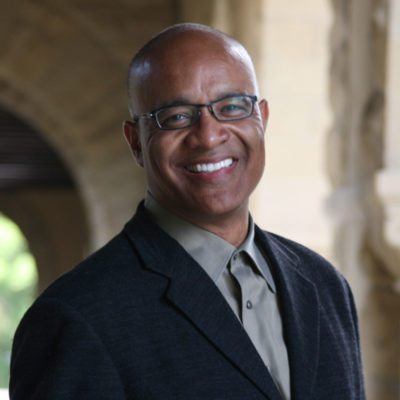
Ralph Richard Banks joins UC Law SF as the 2025 Wiley Manuel Visiting Scholar and Professor with the Center for Racial and Economic Justice.
- Ralph Richard Banks brings decades of expertise in constitutional law, family law, and racial justice to UC Law SF as this year’s Wiley Manuel Visiting Scholar and Professor in the Center for Racial and Economic Justice.
- He urges students to examine all sides of an issue, resist ideological extremes, and ground their arguments in facts, fairness, and real-world impact.
- He will teach a spring seminar investigating how higher education intersects with race, class, and the promise of the American Dream.
Ralph Richard Banks has spent his career tackling some of the most complex and emotionally charged issues in American life: race, inequality, family, and education. A longtime professor and acclaimed legal scholar, he sees confronting these topics as an opportunity to train better lawyers—and better citizens.
“I push students to understand the other side,” Banks said. “To evaluate arguments from a third-party perspective, dissect claims, and treat them fairly. That’s what characterizes a good lawyer, no matter what setting you are in.”
This year, Banks brings his signature approach to UC Law San Francisco, where he’ll serve as the Wiley Manuel Visiting Scholar and Professor with the Center for Racial and Economic Justice (CREJ). He will lead a spring seminar on race, meritocracy, and education—topics that are increasingly at the center of national debate.
“Professor Banks’ scholarship and approach to racial justice are needed now more than ever,” said CREJ Co-Director Shauna Marshall. “The UC Law SF community is indeed fortunate to have his expertise on our campus as this nation grapples painfully with concepts of equality and racial justice.”
Banks has spent more than 25 years on the Stanford Law School faculty, where he teaches constitutional law, family law, and courses on race and the law. He’s also the founding director of Stanford’s Center for Racial Justice and the author of two leading casebooks and the 2011 book, “Is Marriage for White People? How the African American Marriage Decline Affects Everyone,” exploring how intimate relationships are connected to race and equality.
Banks said he views his areas of expertise as deeply interconnected, describing them as the place where the law meets people’s lives.
“Family law regulates people in their most intimate relationships, and issues of race are central to both family law and constitutional law,” he said.
Banks is currently working on a new book, “The Big Sort: How College Can Make or Break the American Dream,” set for release in 2026. It asks some hard questions: Has higher education delivered on its promise of opportunity and upward mobility? Why hasn’t college done more to close racial gaps? And why has it become such a lightning rod in our political culture?
“Higher education is one way people have sought to overcome the legacy of slavery and Jim Crow,” Banks said. “But it hasn’t been rooted out thus far, so what gives?”
His forthcoming seminar at UC Law SF will delve into these questions, inviting students to explore the tensions between merit-based opportunity and efforts to redress inequality. And like all of Banks’ teaching, it will resist easy answers.
“It’s about approaching issues with open minds and basing your views on facts and data as you explore how these controversies are best resolved,” he said. “It’s not to favor or promote the interest of one particular group. The interests we should promote are the interests of society.”
Banks cautions against extreme views and rigid thinking on thorny questions, like whether the U.S. is truly a meritocracy, noting that the answer requires nuanced analysis.
“It’s important to recognize that America is more of a meritocracy than most other nations, and more than we’ve been in the past. That’s a source of our greatness,” he said. “But we also have serious failings. We are not as meritocratic as we should be.”
He wants students to wrestle with those contradictions and think about solutions to society’s most vexing challenges.
“If we want to make this nation work, we have to have a system where people feel they have opportunity to lead a good life and have hope for their children,” he said.
Before entering academia, Banks earned his law degree from Harvard, clerked for U.S. District Judge Barrington D. Parker in the Southern District of New York, and practiced law at O’Melveny & Myers. These days, he’s most energized by the opportunity to exchange ideas with students who bring fresh perspectives and life experiences to the classroom.
“I hope to introduce students to ideas they’ve wrestled with, or maybe haven’t thought as deeply about,” he said. “But more than that, I want to inspire them to have big dreams, big goals, big ideas, and the confidence to pursue them.”
CREJ Co-Director Thalia González said Banks’ presence on campus this year is an opportunity for students and faculty alike to grapple with the complexities of advancing racial and economic justice.
“The Center for Racial and Economic Justice is thrilled to host Professor Banks as the Wiley Manuel Visiting Scholar and Professor this academic year,” she said. “His expertise in race and law, and in particular higher education, will enrich the intellectual life of UC Law SF, provoking critical discourse about equity, opportunity, and democracy.”