UC Law SF Professors Explore Supreme Court’s Impact on Individual Rights and Government Power
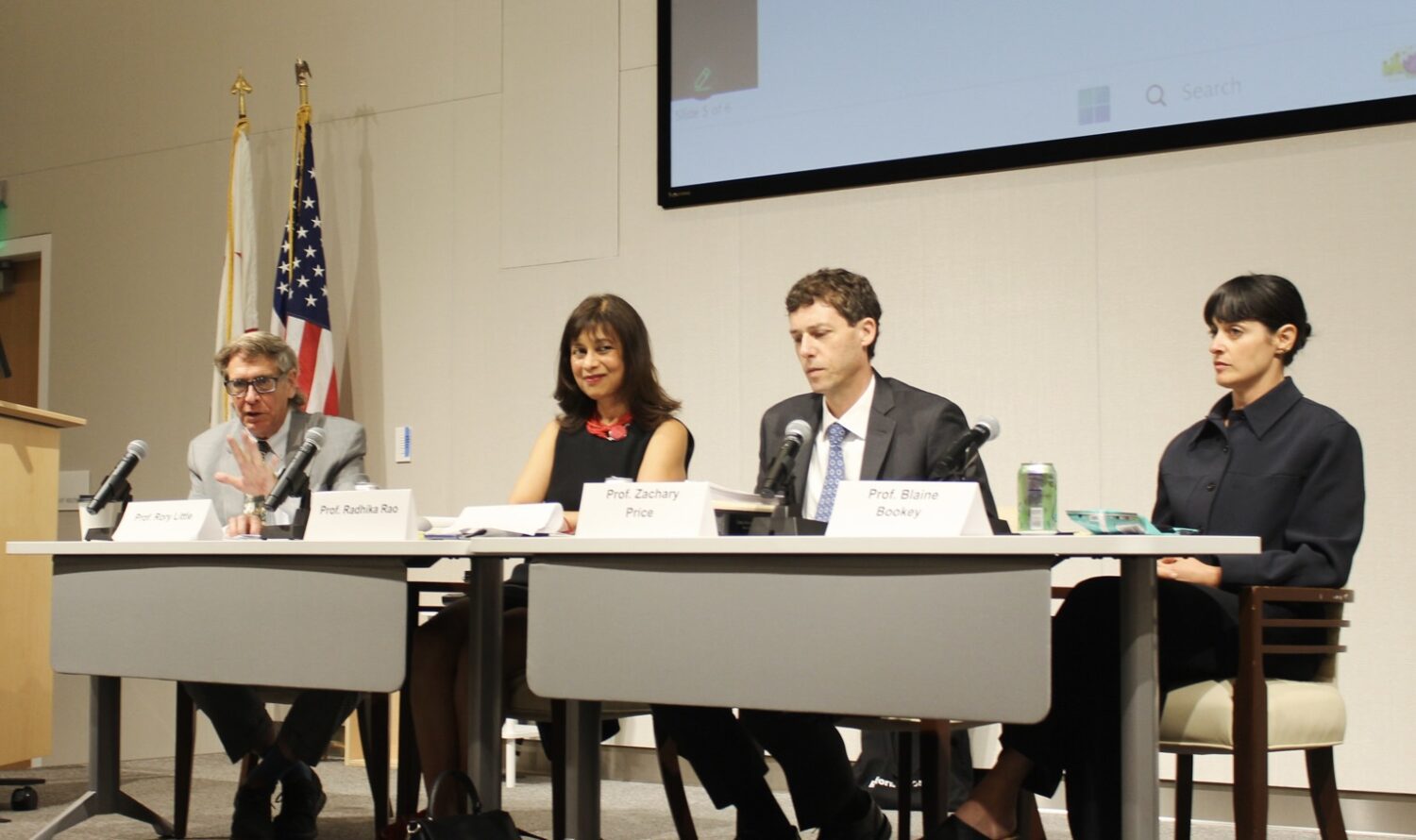
UC Law San Francisco Professors Rory Little, Radhika Rao, Zachary Price, and Blaine Bookey discuss high-profile Supreme Court cases on topics including gender-affirming care bans, immigration enforcement, and capital punishment, exploring how they could impact constitutional rights and democratic institutions.
- UC Law SF professors analyzed recent and pending Supreme Court cases affecting constitutional rights and government authority.
- Panelists explored high-profile issues, including gender-affirming care bans, emergency orders on immigration enforcement, and capital punishment.
- Faculty insights help students and the public better understand complex legal debates and their societal implications.
Can states ban gender-affirming care for youth? Can police be held liable for mistakenly raiding the wrong house? Can the government detain suspects based on their skin color and deport people to countries they’ve never been to?
Professor Radhika Rao analyzes the Supreme Court’s approach to gender-affirming care bans, urging deeper examination of how such laws intersect with constitutional guarantees of equal protection.
These were among the legal questions UC Law San Francisco professors examined at the annual U.S. Supreme Court Review and Preview on Sept. 24, organized and moderated by Professor Rory Little.
Gender-Affirming Care Bans
Professor Radhika Rao opened the panel by discussing United States v. Skrmetti, in which the court upheld state bans on gender-affirming care for minors. Chief Justice John Roberts, writing for the majority, said the law did not discriminate based on gender but prohibited care for certain conditions, such as gender dysphoria.
Rao strongly disagreed with the opinion, stating that it failed to honestly and thoroughly examine the question of whether such bans violate the Fourteenth Amendment’s Equal Protection clause.
“This involves many difficult theoretical and empirical questions, and the court evaded all of that — and the opportunity to engage in deep, real analysis,” Rao said.
Professor Zachary Price examines recent Supreme Court rulings on federal agency authority and presidential power, highlighting how the justices are redefining the balance of power between branches of government.
The Administrative State
Professor Zachary Price turned to three cases on federal agency authority. In FCC v. Consumers’ Research, the court upheld FCC’s authority to let a private entity set telecom fees to support rural communications. In Kennedy v. Braidwood Management, it upheld a task force requiring insurers to cover preventive care. In Trump v. CASA, Inc., it limited district courts’ ability to issue nationwide injunctions, allowing presidential administrations to implement new policies with less judicial interference.
Together, Price said, these rulings suggest the court may pause its recent trend of dismantling decades-old structures of administrative government, as it did in Loper Bright Enterprises v. Raimondo in 2024, which ended deference to reasonable agency interpretations of federal law.
“These three decisions may suggest that the court has gone as far as it will go in holding the federal administrative state unconstitutional,” Price said.
Professor Blaine Bookey discusses the Supreme Court’s expanded use of the emergency docket and its impact on immigration enforcement, due process, and judicial transparency.
The “Shadow Docket”
Professor Blaine Bookey analyzed the court’s emergency docket, dubbed by some as the “shadow docket” for its frequent lack of written explanations of decisions. She cited dissents by Justice Sonia Sotomayor to recent emergency orders that allow the Trump administration to deport immigrants to countries where they have no ties, including Libya, South Sudan, and El Salvador.
She also highlighted a Sept. 8 order lifting restrictions on detaining individuals in Los Angeles based on race, language, and other factors that critics denounce as “racial profiling.” She noted the administration sought emergency review in 19 cases within its first few months — far more than the eight filed over 16 years when George W. Bush and Barack Obama were in office.
“This is a huge fundamental shift in how the court is operating,” Bookey said, adding that emergency rulings create confusion for lower courts and can cause irreversible injury to litigants, including those who claim they were tortured in El Salvador after being deported there.
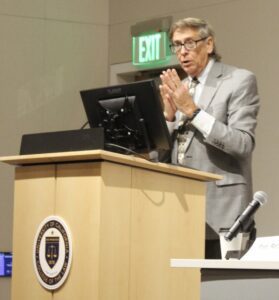
Professor Rory Little explains how recent and pending Supreme Court cases could reshape standards for police accountability and capital punishment.
Police Accountability and Capital Punishment
Turning to criminal law, Little looked at three cases involving police accountability and capital punishment. In Martin v. FBI, the court found the government could be liable for mistakenly executing a no-knock search warrant at the wrong house. In Barnes v. Felix, it ruled that police use-of-force cases should consider the “totality of circumstances,” not just an officer’s perception of threat in a single moment. Both cases were decided unanimously.
Little also previewed Hamm v. Smith, a pending case on whether the state of Alamba can execute an allegedly intellectually disabled man for capital murder. The outcome could revisit the constitutionality of executing disabled persons.
“A couple of justices have said they don’t like the entire line of cases that led up to this idea that you can’t execute disabled people,” Little said. “So people are very worried that Hamm is going to be a mechanism for changing the law with regard to who you can execute.”
By unpacking some of the court’s most consequential cases, UC Law SF professors apply their expertise to foster a deeper understanding of legal disputes that affect individual rights and democratic institutions.