Making Waves: How UC Law SF’s New Artwork Inspires Reflection on Law’s Reach
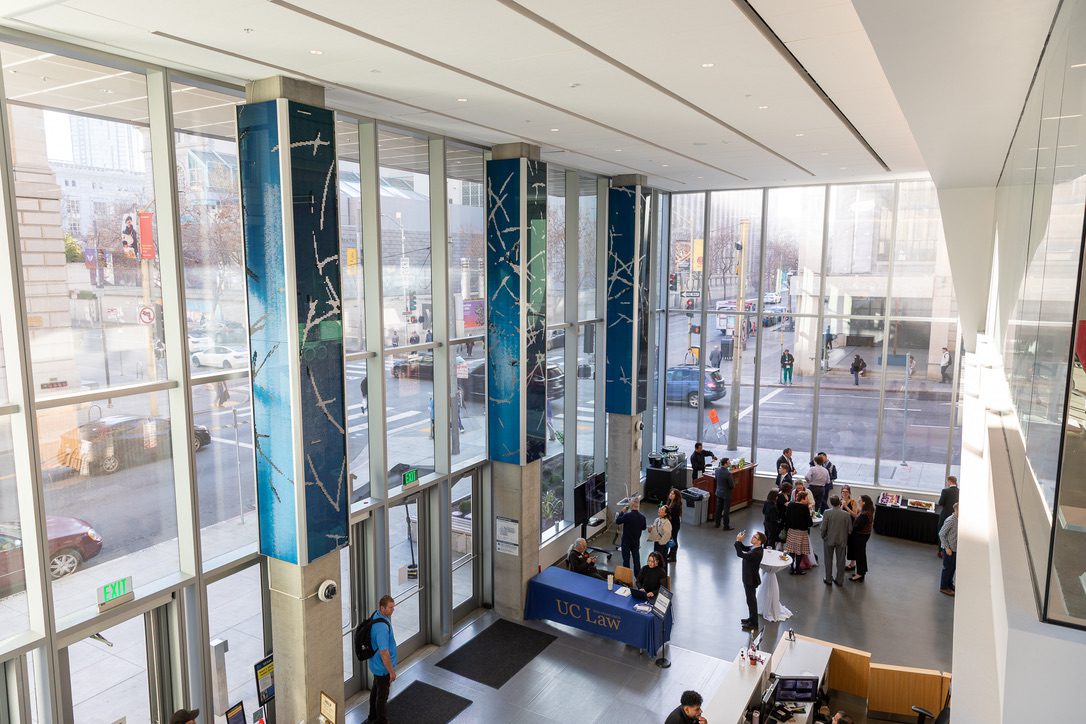
Data-driven wave patterns flow across three towering columns in UC Law San Francisco’s 198 McAllister St. building, surrounding students and visitors with a visual reminder of law’s impact on society over time.
- A new data-driven art installation at UC Law SF visualizes how landmark court cases ripple through society over time.
- Tidal Wave of Justice blends law, technology, and art to remind students of the enduring power of legal decisions.
- The installation challenges future lawyers to reflect on the impact their own work will have on justice and society.
In the fast-paced world of law school, it’s easy for students to lose sight of the big picture: why they’re here, and why they want to be attorneys. But a new art installation at UC Law San Francisco invites students — and campus visitors — to pause, reflect, and be inspired.
Tidal Wave of Justice, a data-driven piece by artist Dan Goods, transforms the atrium of UC Law SF’s newest building into a visual reminder of the law’s enduring impact. Virtual waves symbolizing how often landmark cases like Brown v. Board of Education are cited flow across three massive pillars, showing how key rulings ripple through society over time.
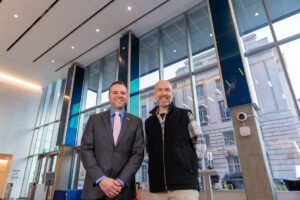
Christopher Gabriel of Stratin Engineering and artist Dan Goods led the concept, design, and installation of a massive digital art piece that turns live court data into visually stunning wave patterns.
Goods, a visual strategist at NASA’s Jet Propulsion Lab (JPL), collaborated with Stratin Engineering to design the unique display. It uses more than 125,000 magnetized dots — blue on one side, silver on the other — that flip in varied sequences to create wave patterns. The result is a stunning blend of art, technology, and law, visible to anyone passing by the tall glass façade of the 198 McAllister St. building, which opened in 2023.
The installation was celebrated at a Feb. 6 ceremony where guests enjoyed hors d’oeuvres and heard remarks from Goods and Chancellor & Dean David Faigman. Find photos from the event here.
A Space for Reflection
Faigman described the installation as both modern and timeless, a reflection of UC Law SF’s nearly 150-year legacy and its forward-looking approach.
“When you’re standing in that space, you feel you’re at the vanguard of law, technology, and science,” Faigman said. “But you’re also grounded in history because so many of these cases date back to the 19th century.”
UC Law SF also stands at the vanguard, Faigman said, with programs like LexLab and the Startup Legal Garage, which prepare students to work with emerging companies that develop new life-changing technologies.
For students, Faigman added, Tidal Wave of Justice is more than art; it’s a reminder that law has the power to transform society, and so do they.
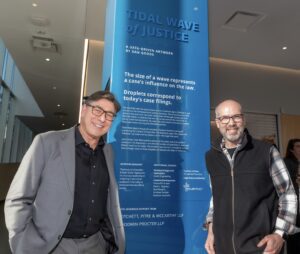
The wave-pattern concept emerged from a conversation between Chancellor & Dean David Faigman and artist Dan Goods about the impact of law on society.
“We don’t yet know what cases will be the most influential for determining society’s relationship with technology during the coming decades,” he said. “But our graduates will be right there at the center of it all.”
Waves of Justice and a Poetic Inspiration
The concept for the piece emerged in a conversation between Goods and Faigman, who likened the law to waves — big and small — that shape society. Goods was captivated by the metaphor and later found poetic resonance in “The Cure at Troy,” a 1991 poem by Seamus Heaney that speaks of a “longed-for tidal wave of justice” that can make “hope and history rhyme.”
Using live data from Free Law Project ’s Court Listener, Tidal Wave of Justice displays real-time updates on case citations. The artwork shows a case name, followed by a wave pattern reflecting how many times a case has been cited in state and federal court rulings. Waves surge across nine 17-by-2-foot panels. Water droplets then ripple across the display, symbolizing how many times a case was cited in new court filings that day.
“We’re thrilled to empower this art and to show the students, staff, and faculty at UC Law San Francisco the impact the justice system has in our society,” said Michael Lissner, executive director of the Free Law Project, a nonprofit that uses data and advocacy to make the legal ecosystem more equitable and competitive.
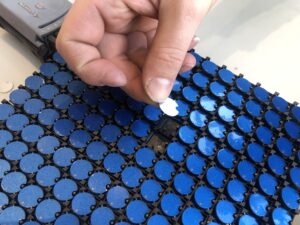
More than 100,000 two-sided flip dots turn in carefully choreographed sequences, forming wave patterns to symbolize how landmark legal decisions create lasting societal change.
Data Meets Design
Goods is no stranger to weaving data into art. His past works include eCLOUD, a unique sculpture that reflects real-time weather data at the San Jose Airport, and Pulse of Exploration, which visualizes the real-time transmission of space data with cascading strands of light at NASA’s JPL.
When Faigman visited the JPL for an architectural presentation, he was captivated by the Pulse of Exploration piece and Goods’ ability to turn complex data into meaningful imagery. He approached Goods about creating a data-driven piece for UC Law SF’s new building — one that would tell a visual story about the impact of law.
Engineering Ingenuity
Christopher Gabriel of Stratin Engineering led a team of more than a dozen engineers, fabricators, and installers working to integrate the artwork into the building’s existing architecture. The team used 306 concrete anchors to secure nine display frames to three massive columns.

Dylan Lukes, Kaden Neary, and Christopher Gabriel of Stratin Engineering tackle the complex technical challenges of designing and installing a large-scale artwork that illustrates the power of legal precedent.
Energy efficiency was a top priority to meet the building’s LEED certification standards. The team used flip-dots, a technology first developed in the 1960s that uses a fraction of the energy needed to power an LED flatscreen. To simulate wave patterns, real-time data feeds into a sophisticated graphics-processing system, calculating how millions of water and foam particles behave — replicating the randomness and beauty of real waves crashing against a sandy beach.
“No two waves will ever be the same,” Gabriel said. “Because of the real-time fluid simulation, every single wave is unique.”
Sparking Reflection, Inspiring Change
The installation invites students to consider their role in shaping the legal landscape, reminding them that their future work will contribute to the ripple effects of justice.
Funded entirely by private donations, including support from Cotchett, Pitre & McCarthy and Goodwin Proctor, the project reflects the collective belief in law’s transformative power. Individuals and law firms can still make a lasting impact by supporting this project. A $100,000 contribution secures prominent recognition on a display near the installation, highlighting donors’ commitment to justice and legal education.
Goods said he hopes the waves inspire reflection on the law’s reach and the role each student plays within it.
“I hope they look at the waves and ask, ‘What kind of impact will I make?’” Goods said. “What waves will I create?”