Scholars Explore Voting Rights, AI, and the Future of Elections at UC Law SF
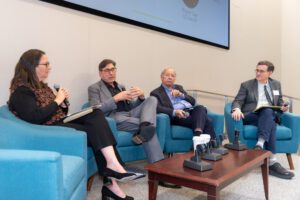
A conversation about American democracy and the rule of law on Feb. 6 includes Center for Constitutional Democracy Executive Director Nicole Ozer, UC Law SF Chancellor & Dean David Faigman, NYU Law Professor Emeritus Burt Neuborne, and UC Law SF Professor Reuel Schiller.
Leading scholars and practitioners came together to discuss voting rights, democracy, and elections at UC Law San Francisco on Feb. 6 for the Constitutional Law Quarterly’s spring symposium, co-sponsored by the Center for Constitutional Democracy.
The symposium was titled: From the Voting Rights Act to Artificial Intelligence: The History and Future of Free and Fair Elections.
Reflecting on the symposium, Mallory Yeates, third-year law student and executive symposium editor of the Constitutional Quarterly, highlighted that “so much of legal education occurs in the spaces outside of the classroom that can foster intellectual engagement. We were so grateful to prompt discussions for attendees to engage critically with both longstanding and emerging threats to democratic participation, and most importantly, to do so in community.”
The symposium began with a morning conversation between San Francisco City Attorney David Chiu and UC Law SF Chancellor and Dean David Faigman. In a wide-ranging discussion, Chiu spoke about recent federal litigation, including efforts to protect state voter files. The conversation closed with an encouraging message from Chiu about the value of public service. He urged law students to think deeply about the impact they hope to make through their legal career. See a recording of their conversation here..
The first panel focused on recent redistricting efforts in Texas and California, including a deep dive into California Proposition 50 and its potential effects, as well as the overall legal and political climate related to electoral districts and upcoming elections. The panel was moderated by Professor Reuel Schiller of UC Law SF and featured Margaret Prinzing of Olson Remcho, Andrew Shen of the Renne Public Law Group, Eric McGhee of the Public Policy Institute of California, and Brittany Stonesifer of Common Cause California. Watch video of the panel talk.
The second panel, Artificial Intelligence and Democracy, addressed the opportunities and challenges that new AI systems pose to voting rights, free and fair elections, justice, and democracy. Panelists focused on the limitations of the current legal regime to address advances in AI technology and new laws being enacted in California and other states. The panel was moderated by Center for Constitutional Democracy Executive Director Nicole Ozer and featured Matt Cagle of ACLU of Northern California, Brittan Heller of Stanford Law School, Shu Dar Yao of Lucid Capitalism, and David Evan Harris, Michah Weinberg, and Vera Zakem from UC Berkeley. View a recording of their discussion.
The third panel examined the history of the Voting Rights Act (VRA) of 1965 from multiple perspectives and how the Louisiana v. Callais case, currently being decided by the U.S. Supreme Court, will affect the future of voting rights protections. Throughout the discussion, panelists engaged deeply with the Equal Protection Clause, the purposes and effects of gerrymandering, and the precise language of Section 2 of the VRA. The conversation underscored the high stakes of the Court’s forthcoming decision and its potential to reshape the legal landscape of voting rights enforcement. The panel was moderated by Professor Zachary Price of UC Law SF and featured Professor Matthew Coles of UC Law SF, Nicholas Green of the California DOJ, Civil Rights Enforcement Section and Jesse Mainardi, adjunct professor of law at UC Law SF. Watch video of their talk here.
Following the morning symposium panels, attendees viewed a special short-form version of the PBS documentary, The American Revolution, followed by a Rule of Law and Democracy discussion panel. The panel was moderated by Ozer, and featured Faigman, Schiller, and NYU Law Professor Emeritus Burt Neuborne.
The panelists discussed the structures of American democracy and its strengths and weaknesses; perspectives on historical political, social, and legal challenges; and current threats to the rule of law. The scholars emphasized that the rule of law is not self-executing and depends on civic engagement and a shared commitment to constitutional governance, while also highlighting the resilience of democratic institutions. See video of their discussion here.
“It was wonderful to help support the CLQ spring symposium,” Ozer said. “The full day of discussion reflects the Center for Constitutional Democracy‘s ongoing commitment to fostering rigorous dialogue on pressing constitutional issues and supporting innovative work across strategy to defend and advance rights, justice, and democracy.”