National Legal Masters Conference at UC Law SF Highlights Growing Demand for Professionals with Legal Training
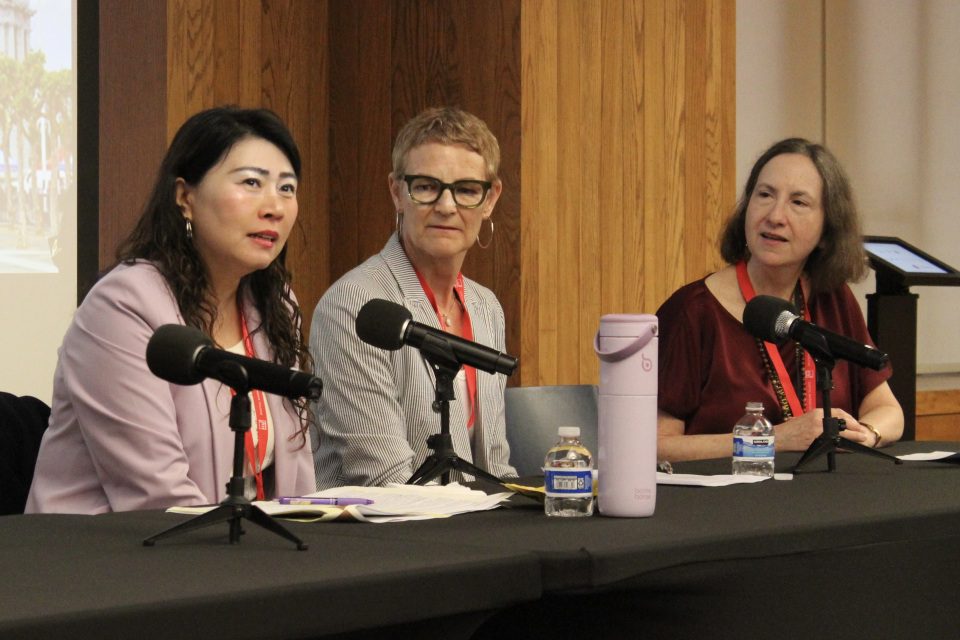
Lucy Dong (left) explains how UC Law SF’s Master of Legal Studies (MLS) program equipped her to excel in her job during a panel talk with fellow MLS alum Rosalie Lack (center) and Associate Dean of the MLS Program Jessica Vapnek (right).
- Legal master’s degrees help professionals gain practical legal knowledge without pursuing a JD, enabling them to grow in their current roles, change jobs, and advance in their careers.
- UC Law San Francisco hosted educators from across the country to discuss best practices for these growing programs.
- UC Law SF graduates say the training helps them work more effectively with lawyers and lawmakers while navigating complex legal issues at work.
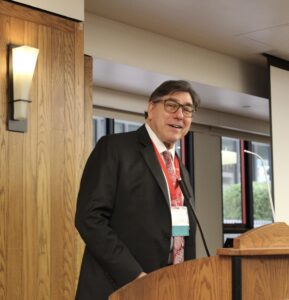
Chancellor & Dean David Faigman shares how legal master’s programs help professionals deepen their understanding of the law while bringing their own industry expertise into classroom discussions.
Educators from across the country exchanged knowledge and best practices about non-JD legal master’s programs at UC Law San Francisco from March 2 to 4 at the ninth annual National Legal Masters Conference.
Chancellor and Dean David Faigman opened the conference with welcome remarks, addressing representatives from more than 45 law schools and universities. Faigman, who helped launch the Master of Studies in Law (now Master of Legal Studies) and Master in Health Policy and Law (HPL) with the University of California San Francisco (UCSF) in 2012, highlighted the value of such programs for non-lawyer professionals.
“Anyone who works with lawyers benefits from being able to speak the language of the law,” Faigman said.
He noted that professionals earning their legal master’s not only learn about the laws that shape their work; they also enrich the classroom with their own experiences. He cited a chief medical officer from a local hospital who shared insight during a lesson on physician-assisted suicide, explaining to classmates “what it means to families to be in an ICU, to make those final judgments about palliative care.”
Faigman joined other law school deans for a panel discussion on legal master’s programs. He described how UC Law SF expanded its legal master’s program from a focus on health law to a more general degree for professionals with options to specialize their studies in certain areas, such as business, employment, and environmental law. UC Law SF legal master’s students can take courses alongside JD students and complete their degrees in one to four years through in-person, online, or hybrid formats.
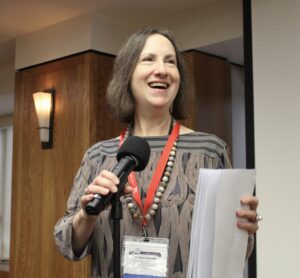
Associate Dean Jessica Vapnek says the MLS program attracts professionals from diverse backgrounds who want to better navigate the laws and legal systems that shape work.
The conference also featured an alumni panel with graduates of UC Law SF’s MLS program, including Irella Blackwood, chief financial officer of the San Francisco Public Utilities Commission, and Lucy Dong, director of finance and administration for the San Mateo County Flood & Sea Level Rise Resiliency District.
Dong said environmental law courses at UC Law SF equipped her with skills and knowledge that she uses routinely in her job, where she often interacts with lawyers, elected officials, and state agencies. Since earning an MLS degree, Dong said she gets invited to high-level meetings typically reserved for executives, board members, and legal counsel.
“The legal training has enabled me to provide meaningful and impactful support to my agency,” she said.
Jessica Vapnek, associate dean of UC Law SF’s MLS Program, said the degree program draws professionals from a variety of fields.
“These programs are democratizing legal education, empowering people from many backgrounds to understand legal concepts and interact confidently and effectively with legal professionals,” she said.