3L Rachel Sadler Charts Path in Brain Health, Tech and Policy Through Health Law Concentration
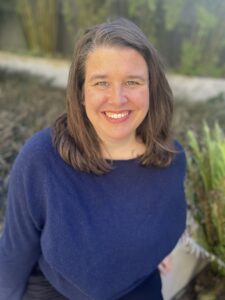
3L Rachel Sadler studies health law and policy at UC Law SF while researching the legal implications of neurotechnology and other emerging tools that may affect human cognition.
3L student Rachel Sadler shares how UC Law SF’s Health Law Concentration prepared her for a career focused on the intersection of brain health, government policy, and technology.
- Gained a detailed understanding of how U.S. health care is regulated and where policy reform is needed through coursework and research.
- Interned with state and federal agencies that regulate health care services and worked with a major health care provider’s bioethics department.
- Plans to pursue a career focused on protecting cognitive liberty and mental privacy as new technologies reshape healthcare.
3L Rachel Sadler:
The Health Law Concentration has given me fluency in one of the most complex regulated industries and the tools to become an effective advocate for better health policy.
Before coming to law school, I spent a decade teaching and working with teachers and administrators on high school programming for multilingual learners. Healthcare kept emerging as the most powerful driver of student outcomes. I wanted to understand how to make effective policy change in this area and how to use existing law to defend people’s health rights in California.
Through the concentration’s coursework, I gained a sophisticated understanding of how U.S. healthcare is regulated. I also learned where the pressure points for reform exist. The courses gave me space to develop what became my central research interest: how law and policy can be built to protect human cognition and healthy brain development, particularly regarding new technologies such as generative AI and neurotechnology. The health law faculty were instrumental in that process, genuinely invested in helping me and other students define and pursue our own intellectual vision.
During law school, I interned at the General Counsel’s Office for Region IX of the U.S. Department of Health and Human Services. I also externed at the California Department of Justice’s Health, Education and Welfare Division. Additionally, I externed at Kaiser Permanente Northern California’s Bioethics Department. Alongside those placements, I conducted extensive independent research on mental privacy and emerging neurotechnology, working closely with Professors Emily Murphy and George Horvath. That research became the throughline of my law school experience and the foundation of my current policy focus.
I must also credit Nicole Ozer of the Center for Constitutional Democracy (CCD), whose deep knowledge of California privacy law and the public-interest privacy landscape deeply informed my work. I currently serve a research assistant with the CCD, where I spearhead the development of K-12 educational resources in partnership with law faculty and students.
I’ve found UC Law SF to be an ideal place for second-career, nontraditional students. There is a tremendous diversity of life and career experience here, and I felt fully welcomed into the community, despite returning as a student at a different stage of life.
I came to law school wanting to promote equity in California’s healthcare system. I am leaving with a sharper and more specific ambition: to build a policy career focused on protecting cognitive liberty and mental privacy from technological intrusion. This is both an urgent and underserved area of law, and I want to be part of defining this landscape going forward. Whether as a practicing attorney or a policy advisor, I plan to work on these issues after law school.
I strongly recommend UC Law SF and the Health Law Concentration. When I arrived in law school, I worried the concentration would be narrow and that my non-clinical background would be a disadvantage. The opposite was true. The health law faculty thinks about health expansively, encompassing social determinants of health, structural inequity, and emerging technologies alongside the regulatory mechanics of the industry. The faculty are accessible, intellectually generous, and genuinely invested in students’ development. I found my research vision here, and I deeply appreciate the concentration’s role in this.
The Evidence of Success series highlights UC Law SF students as they share how the College’s opportunities equip them with the experience, skills, and confidence to excel in the legal profession.