Global Democracy Expert Melissa Hooper to Lead UC Law SF’s Center for Constitutional Democracy
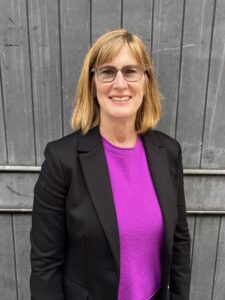
Melissa Hooper previously worked with lawyers and advocates in Russia, Ukraine, Hungary and other nations to strengthen human rights protections and democratic institutions.
- Melissa Hooper brings global lessons and experiences to her new role as executive director of UC Law SF’s Center for Constitutional Democracy.
- She has defended protesters and dissidents in Russia and Uzbekistan, helped build anti-corruption systems in Ukraine, and developed strategies to counter autocratic shifts in Hungary.
- She plans to bring global experts to campus, file amicus briefs in significant cases, and work with policymakers to strengthen constitutional protections.
After spending much of her career defending democratic institutions in countries facing authoritarianism, Melissa Hooper is bringing a global perspective to her new role as executive director of UC Law San Francisco’s Center for Constitutional Democracy.
Hooper spent years working to defend the rights of protesters and dissidents in Russia and Uzbekistan, helping build anti-corruption systems in Ukraine, and developing strategies to counter autocratic gains in Hungary and other nations. She did so in her roles as director and lead counsel for the international nonprofit Human Rights First and as regional director of the American Bar Association’s Rule of Law Initiative.
“I’m excited to bring these strategies and ideas for strengthening constitutional rights overseas to the center,” Hooper said.
Hooper, who starts her new role on Aug. 17, plans to expand the center’s work through public programming, litigation, scholarship, and policy advocacy while engaging students in efforts to bolster constitutional democracy.
One of her top priorities is connecting UC Law SF students and the broader legal community with judges, lawyers, and advocates from countries that have confronted threats to democracy firsthand. She aims to bring those voices to campus to share lessons from their experiences resisting authoritarianism in countries such as Hungary and Poland.
“I want their stories to inspire American lawyers, judges, and law students,” she said, “to show them exactly how people in similar circumstances reacted in ways that were and were not successful.”
Hooper plans to build on a strong foundation laid for the center by its founding executive director Nicole Ozer, now a senior scholar affiliated with the center and executive director of the Electronic Frontier Foundation. Hooper intends to file amicus briefs in significant constitutional cases, convene discussions on emerging rule-of-law issues, and work with state policymakers on measures that strengthen constitutional protections and government accountability.
Among the issues she is most interested in exploring are state-level efforts in California and elsewhere to strengthen democratic institutions and individual rights. She cites as examples initiatives launched in Illinois and Minnesota to investigate alleged constitutional violations by federal officials during aggressive immigration enforcement operations.
“It’s about how to document and hold individuals accountable for anti-democratic actions and also how to enact better policies that protect Californians,” she said.
Students will play a central role in the center’s future, Hooper said.
“I want to bring young people into the conversation about how we are going to reimagine and rebuild our institutions,” she said.
Before working on democracy and human rights issues overseas, Hooper represented individuals on death row in California and led teams investigating and litigating post-conviction capital cases. She served as supervising attorney at the California Appellate Project and as a habeas attorney at the Habeas Corpus Resource Center.
“Working on death penalty cases, I’ve seen the limitations of our U.S. legal system and constitutional protections,” she said. “I look forward to combining that experience with my work overseas to advocate for laws and policies that strengthen constitutional rights.”
Hooper earned her law degree from UC Berkeley School of Law and has served as a senior fellow at UC Berkeley’s Edley Center on Law and Democracy and as a non-resident scholar at Stanford Law School, where she researched international efforts to protect the rule of law. She has testified before Congress on democratic backsliding in Hungary and human rights violations in Russia.
Hooper believes those experiences offer important lessons as the United States grapples with debates over constitutional governance, the rule of law, the conduct of elections and the resilience of democratic institutions.
“What we’re experiencing in the U.S. is part of a global trend,” she said.
Educating community members is another key priority for the center. Ultimately, she said, protecting democracy depends not only on courts and governments, but also on engaged communities.
“While democracy operates at the national level, it depends on the actions of individuals and their communities,” she said.