National Leader in Constitutional Rights and Technology Nicole Ozer Directs UC Law SF’s New Center for Constitutional Democracy

Since 2004, Nicole Ozer has worked at the forefront of the intersection of constitutional law, civil rights, and emerging technology, shaping some of the most significant privacy and technology laws and policies in the country.
- Constitutional rights and technology law expert Nicole Ozer will lead UC Law SF’s new Center for Constitutional Democracy, bringing more than 20 years of experience shaping privacy laws and policies and defending and advancing constitutional rights.
- The center will bring together scholars, attorneys, and community leaders to produce innovative research, influence policy, educate future attorneys, and create practical strategies to defend and advance rights and promote democracy amid rapid technological change.
- Ozer’s accomplishments include leading coalitions that passed landmark state privacy laws, establishing oversight models for surveillance, crafting influential amicus briefs at all levels of state and federal court, and advocating globally for digital rights, earning wide recognition for her work.
Nicole A. Ozer, a leader in cutting-edge legal work to defend and advance constitutional rights, democratic oversight, and the rule of law in the AI age, has been named the inaugural executive director of UC Law San Francisco’s Center for Constitutional Democracy.
The center will serve as an academic hub and action center to advance and defend constitutional rights and democratic principles, including privacy, due process, free speech, and separation of powers. It will bring together attorneys, community leaders, advocates, and scholars from key disciplines to produce influential research, develop innovative educational and practice experiences for students, and lead high-impact legal projects in courts, legislatures, and communities.
Ozer’s experience includes developing and directing the technology and civil liberties program at the ACLU of Northern California for more than 20 years. She led the organization’s development of legal strategy across its statewide work. Her work included spearheading the passage of landmark laws and drafting influential amicus briefs on constitutional issues at all levels of state and federal court, including the California Supreme Court and United States Supreme Court. Ozer has also held research appointments at Harvard, Stanford, and UC Berkeley.
“Our constitutional and civil rights, the rule of law, and the very fabric of democracy are facing challenges on many fronts in a period of rapid technological change,” Ozer said. “I am honored to lead UC Law SF’s new Center for Constitutional Democracy at this critical time. I look forward to driving innovative work that advances rights, justice, and democracy, and makes a real difference in people’s lives.”
Her initial priorities for the center include:
- Working across legal strategy in the courts, legislatures, and in communities to defend and advance U.S. constitutional rights and California law.
- Anticipating and proactively addressing threats to constitutional rights and democratic institutions in an era of rapid AI and other technological change.
- Turning scholarship into action that wins critical cases, passes landmark laws, and makes a difference in people’s lives.
- Building collective power through broad coalitions that bridge divides and center diverse community members.
- Training the next generation to utilize integrated advocacy and effectively work across strategies to drive change.
Throughout her career, Ozer has worked to identify threats to constitutional and civil rights and address them through integrated advocacy approaches that combine strategic legal work in the courts, legislatures, with companies, and in communities. Ozer also has a track record of working across the political divide on dozens of landmark laws and policy initiatives.
Building on that record of proactive work and broad-based collaboration, the center will pursue a wide-ranging agenda: conducting research, shaping policy, hosting symposia, and defending and advancing rights in court through strategic litigation and amicus briefs.
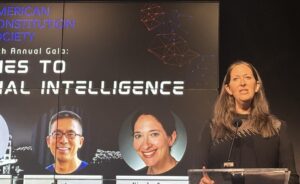
A recognized national voice on constitutional rights and technology law, Nicole Ozer speaks frequently at conferences, public events, and government proceedings, and has held research appointments at Harvard, Stanford, and UC Berkeley.
“Democracy is an everyone issue, and the center will build bridges to engage in collaborative, strategic projects across subject matters to protect and advance rights and make democracy work for more people,” Ozer said.
Ozer views democracy and technology as inseparable issues.
“In 2025, we rely on technology to connect, communicate, and access essential services every day,” she said. “It’s clear that how technology is built and used can control our daily lives, influence our system of governance, and be a threat to liberty.”
She also stresses the importance of state constitutions—especially California’s, which provides more expansive privacy protections than its federal counterpart. Protecting and advancing privacy and free expression rights, she believes, is essential to keeping democracy strong at every level of government.
“People must be free to speak and act in dissent without fear of surveillance and government reprisal, or healthy democracy will break down and authoritarianism can take hold,” she said
The center will also provide a platform for informed public discourse, student learning, and policy innovation as AI and other fast-moving technologies present new challenges to individual rights that are the bedrock of democracy.
“It is essential to both fully utilize existing law and craft new law that is needed to make a difference in people’s lives,” she said. “The Center for Constitutional Democracy will be an intellectual hub and action center driving innovative work to address current threats and anticipate emerging issues that will affect people in California and beyond. Together, we will meet the moment and build for the future.”
Founding a New Center
Chancellor & Dean David Faigman, who established the center and led the nationwide search for its executive director, emphasized Ozer’s exceptional record of leadership and how her dedication to protecting rights aligns perfectly with the center’s mission.
“Nicole has been a national leader in cutting-edge law and policy to advance constitutional rights, justice, and democracy for more than two decades,” Faigman said. “The Center for Constitutional Democracy upholds our law school’s mission of exceptional teaching, influential scholarship, and exemplary public service, along with our belief in the power of law to advance democracy and safeguard constitutional values.”
The center’s establishment is being funded by donors to UC Law SF.
“For generations, donors have stepped up to help UC Law SF excel in innovative research and shape the future of the legal profession,” said Chief Advancement Officer Julia Jordan. “Their support allows us to take bold, meaningful steps to address timely and longstanding issues that require focused legal work and long-term commitment.”
The Center for Constitutional Democracy joins a network of 17 research and programmatic centers at UC Law SF spanning business, health law, dispute resolution, and innovation.
Nicole Ozer’s National Impact
Since 2004, Ozer has worked at the forefront of the intersection of constitutional law, civil rights, and emerging technology. She launched the ACLU of Northern California’s Technology and Civil Liberties Program, transforming it from an idea on paper to a national model for advancing equity and justice in the digital age.
Over two decades, she has shaped some of the most significant privacy and technology laws and policies in the country, including:
- The California Electronic Communications Privacy Act: Ozer spearheaded the passage of CalECPA, leading its coalition of 50 civil rights groups, technology companies, and academics to enact the nation’s strongest electronic surveillance law and require a warrant for government access to electronic information.
- The California Reader Privacy Act: Ozer was instrumental in modernizing California law to protect reading records in the digital age and require a “super warrant” for government access.
- Groundbreaking National Model for Surveillance Oversight: Ozer’s model law for local democratic oversight for surveillance systems inspired 25 laws across the country that safeguard the rights and safety of more than 17 million people.
- Global advocacy: Ozer developed multi-year campaigns to strengthen the anti-surveillance policies related to social media surveillance and face recognition of major technology companies and foster stronger privacy and free expression protection for billions of users worldwide.
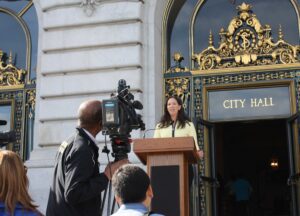
Nicole Ozer speaks in front of San Francisco City Hall about the launch of a campaign that inspired passage of surveillance oversight ordinances in municipalities across the nation.
“It’s really fulfilling to know that the laws, cases, and policy projects I have worked on addressed imminent threats to people’s privacy and free expression—rights that are the fabric of democracy,” she said. “There is no more important time to be working across legal strategy to fully utilize current laws and reinforce protections to protect and advance the rights and safety of diverse community members in California and beyond.”
Ozer has also shared her expertise in academic settings. At the Harvard Kennedy School, she tackled global issues at the crossroads of AI, rights, and democracy as a 2024-2025 technology and human rights fellow. She has served as a lecturer UC Berkeley Law and a visiting researcher at Berkeley’s Center for Law and Technology. She was also a fellow at Stanford’s Digital Civil Society Lab, where she studied ways to strengthen global civil society networks to better support rights and democracy in the digital age.
Her work has earned numerous accolades, including the Fearless Advocate Award from the American Constitution Society and a 2025 California Senate resolution commending her “unwavering dedication to defending and promoting civil liberties in the digital world.”
Ozer’s writing on privacy and constitutional law has been published widely, with her most recent work urging California courts to “fully revitalize the reach and intended power” of the state’s constitutional right to privacy in the age of AI. She regularly provides expert testimony for government proceedings, offers commentary in the press, speaks at academic conferences, and presents at national and global forums, including South by Southwest and the Centre for European Policy Studies.
A graduate of Amherst College and UC Berkeley School of Law, Ozer also studied comparative civil rights history at the University of Cape Town, South Africa.
Learn more about the work of the Center for Constitutional Democracy here.