Top Leaders and Scholars Convene to Discuss Threats to the Rule of Law
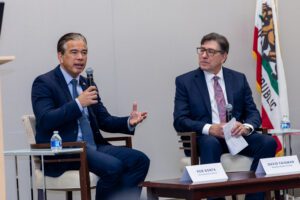
California Attorney General Rob Bonta speaks with UC Law SF Chancellor & Dean David Faigman about states’ constitutional authority and lawsuits filed by his office over efforts to cut research funding, restrict mail-in voting, end birthright citizenship, and more.
- UC Law San Francisco faculty held an all-day symposium bringing together legal scholars and government leaders from across the country to examine recent federal actions and their implications for democratic governance.
- California Attorney General Rob Bonta, UC Berkeley Law Dean Erwin Chemerinsky, and UC Law SF Chancellor & Dean David Faigman spoke about the expansion of executive power, state authority, and civic responses.
- Expert panels discussed immigration enforcement, higher education, and challenges to democratic norms, emphasizing the importance of informed engagement and institutional safeguards.
At a time when federal executive power is expanding in new and sweeping ways, state governments play a vital role in defending democracy and the rule of law, California Attorney General Rob Bonta said in a conversation at UC Law San Francisco.
Speaking with Chancellor & Dean David Faigman in a packed auditorium, Bonta described how his office has filed 46 lawsuits against the federal government in the 42 weeks since President Donald J. Trump began his second term. The cases challenge a wide range of actions taken by the administration, including efforts to void birthright citizenship, restrict mail-in voting, freeze federal funding to states and cities, and deploy the California National Guard to Los Angeles.
“States are standing up, exercising their Tenth Amendment rights as sovereigns to prevent a federal administration that is in power from stripping away their rights, pulling away their critical funding, invading their privacy, raising their costs through unlawful tariffs, sending masked agents to traumatize their communities, militarizing our cities,” Bonta said.
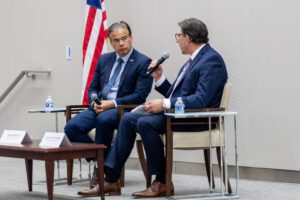
California Attorney General Rob Bonta and UC Law SF Chancellor & Dean David Faigman opened up an all-day symposium with a conversation about states’ rights and contemporary challenges to the rule of law.
His conversation with Faigman opened an all-day symposium on “The Rule of Law and Threats to Democracy.” The Nov. 14 symposium was sponsored by UC Law SF’s Center for Racial and Economic Justice (CREJ); Center for Gender and Refugee Studies (CGRS); Center for Race, Immigration, and Citizenship (RICE); and Center for Constitutional Democracy.
Bonta highlighted what he described as California’s strong record in court, saying the state has prevailed in more than 80% of its challenges so far, often in partnership with other states. Many cases, he said, center on the principle that states have the constitutional authority to protect the health, safety, and welfare of their residents.
Asked about accountability for federal law-enforcement agents amid mass deployments in Los Angeles and other cities, Bonta emphasized that “everyone, including federal agents performing their duties, must abide by the laws of the state of California.”
“There’s no such thing as a license to kill or a license to break state law, criminal law, while you’re engaged in your official conduct,” he said. “There is civil rights accountability for federal officials, as well as criminal liability, should they cross those boundaries and transgress those laws.”
Bonta, who previously served in the California State Assembly and has led the state’s Department of Justice since 2021, also urged law students and attorneys to remember the weight of their professional responsibilities.
“Don’t feel hopeless because we’re not helpless,” he said. “We have a role. We can shape tomorrow.”
He encouraged the audience to stay engaged and committed to upholding democratic values. “Democracy thrives on engagement, participation, fight, and activism,” he said. “It dies in the dark with apathy and neglect.”
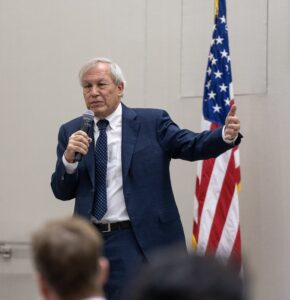
Constitutional scholar Erwin Chemerinsky, dean of UC Berkeley Law, outlines what he sees as unprecedented threats to democracy, urging lawyers and citizens to stay informed, speak out, and defend the rule of law.
A Scholar’s Stark Assessment of American Democracy
The symposium’s keynote address came from Erwin Chemerinsky, the noted constitutional scholar and dean of UC Berkeley School of Law, who delivered the annual Mathew O. Tobriner Memorial Lecture.
Chemerinsky offered a stark assessment of what he views as unprecedented threats to democratic norms and the rule of law.
“No democracy lasts forever,” he said. “It would just be hubris to believe that the United States is immune from the pressures that caused other democracies to fail.”
Chemerinsky outlined a series of actions he believes represent the most serious danger to American democracy in his lifetime. Included among them were what he called “extrajudicial killings” of suspected drug traffickers at sea; prosecutions of perceived political opponents; punitive restrictions targeting certain law firms; the dismantling of federal agencies; and the removal of leaders of independent oversight bodies.
He also criticized the administration’s use of the Alien Enemies Act to deport immigrants to countries where they have no ties, as well as efforts to freeze congressionally approved funding for research and higher education.
“We’ve seen unprecedented violations of the law and the Constitution by the president,” he said. “We’ve seen unprecedented efforts to increase the scope of executive power. And we’ve seen unprecedented use of government power solely for the sake of retribution.”
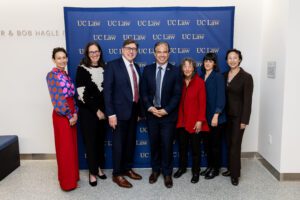
UC Law SF legal scholars and center leaders pose with California’s top attorney. From left to right are Thalia González, co-director of the Center for Racial and Economic Justice; Nicole Ozer, executive director of the Center for Constitutional Democracy; Chancellor & Dean David Faigman; California Attorney General Rob Bonta; Karen Musalo, faculty director of the Center for Gender and Refugee Studies (CGRS); Blaine Bookey, CGRS legal director; and Ming Chen, faculty director of the Center for Race, Immigration, Citizenship, and Equality.
Turning to other branches of government, Chemerinsky said Congress has been largely silent in response to these developments. He commended lower federal courts for blocking multiple executive actions but argued that the U.S. Supreme Court has frequently reversed those decisions and allowed the administration’s policies to proceed.
“The Supreme Court has had a dismal record, overwhelmingly reversing the lower courts and rubber-stamping the actions of the Trump administration,” he said.
He expressed particular concern about the Court’s use of the “shadow docket,” where emergency rulings are issued without explanation, leaving lower courts with no guidance.
Chemerinsky also questioned the reasoning behind the Court’s recent decision to allow passports to list sex assigned at birth, noting that the district court found substantial risks of harm for transgender travelers.
“If you weigh the inequities, how could the Court come to the conclusion it did? It doesn’t even try to justify it,” he said.
Despite his grave concerns, Chemerinsky closed on a note of cautious optimism.
He encouraged audience members to stay informed, speak out, and support organizations working to defend democratic principles.
“Many have said that democracy dies in silence,” he said. “But democracy won’t die if people speak out.”
He pointed to the long arc of American history and the commitment of today’s law students as reasons for hope.
“I believe that our generation will be judged for how we deal with this situation,” he said. “Will we be condemned in the future for capitulating? Or will we be praised for our courage? The answer to that question, I believe, is going to determine the future of the rule of law and democracy in our country.”
The Rule of Law and Threats to Democracy
The symposium also featured panel discussions with legal experts and government officials from across the country exploring critical questions about democratic safeguards, challenges to academic freedom, and legal protections for noncitizens.
In the first panel, CREJ Faculty Co-Director Thalia González moderated a discussion between U.S. District Judge Ana Reyes of the District of Columbia; Professor Zachary Price of UC Law SF; Professor Atiba Ellis of Case Western Reserve University School of Law; and Christina Bull Arndt, chief counsel for special litigation in the California AG’s Office. The speakers addressed the politicization of constitutional law, the importance of democratic participation in upholding the rule of law, how to preserve law’s promise of a multiracial democracy, and the rise of state-level collaborations to respond to federal government actions that may test the limits of constitutional authority.
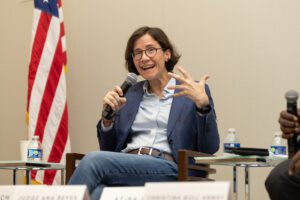
U.S. District Judge Ana Reyes of the U.S. District of Columbia shares her expertise as a federal judge in a panel discussion exploring how legal scholars, attorneys, and others can respond to emerging threats to democracy and the rule of law.
“In a time when the rule of law is being ‘stress tested’ on a daily basis, the panelists and distinguished speakers throughout this symposium called on lawyers, law students, and law professors to step forward and stand together with a shared purpose and collective resolve to defend the central pillars of democracy — from elections and voting to freedom of speech to upholding basic principles of justice and equality,” González said.
Diversity, Equity, and Inclusion, and Higher Education
A second panel explored the impact of recent executive actions concerning higher education and diversity, equity, and inclusion initiatives. Moderated by RICE Faculty Director Ming Chen, the panel included Professor Robert S. Chang of UC Irvine School of Law, on the role that university research centers can play in supporting litigation; Meena Chandra of the University of California Office of the President’s Systemwide Anti-Discrimination Office, on how states and universities are responding to shifts in the U.S. Department of Education’s civil rights enforcement; UC Law SF Professor and Associate Dean for Research Dave Owen, on the role of administrative law in supporting the use of scientific expertise; and Anurima Bhargava, a filmmaker and civil rights attorney, who previously chaired the Education Section of the U.S. Department of Justice, on how to effectively spread the word about education’s role in a democratic society.
“Universities are places to learn about our past and equip the next generation to be responsible citizens and, at UC Law SF, responsible lawyers and leaders in society,” Chen said. “That is why government challenges to universities undermine democracy in a lasting way.”
The Constitutional and Statutory Rights of Non-Citizens
CGRS Faculty Director Karen Musalo led a panel of experts discussing the rights of non-citizens. Panelists included UC Law SF Professor Richard Boswell; Professor Lucas Guttentag of Stanford and Yale Law Schools; Professor Jack Chin of UC Davis School of Law; and Jennifer Chacón of Stanford Law.
The panel examined a range of Trump administration policies affecting non-citizens, including an executive order seeking to end birthright citizenship; arrests based on factors such as race or spoken language; and the use of mandatory detention without release.
“The panelists made clear that non-citizens are not without rights, and that many of the administration’s policies violate those rights – but most importantly – that lawyers are needed to vindicate the rights of those affected,” Musalo said. “In educating attendees, the panelists also issued a call to action: rights don’t enforce themselves, but require lawyers stepping up.”
Spotlighting the new Center for Constitutional Democracy
The symposium also highlighted UC Law SF’s new Center for Constitutional Democracy, which was launched in September and co-sponsored the event. At a reception after the program, Executive Director Nicole Ozer reflected on the value of the symposium and the ways scholarship can be put into practice to defend and promote rights, justice, and democracy.
“The symposium was an extraordinary day of community and learning, of identifying the many challenges, and paving a path forward,” she said. “Together, we can work across issues and disciplines to meet the moment and continue to build for the future.”
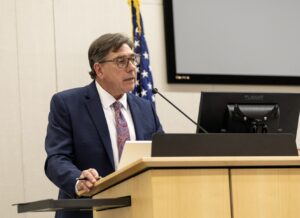
Drawing on lessons from the past, Chancellor & Dean David Faigman explains how the Constitution was designed to withstand threats to democracy through both institutional checks and robust public participation.
Viewing Today’s Challenges in Historical Context
Closing the symposium’s formal program, Faigman urged attendees to place today’s constitutional debates within a broader historical frame. He pointed to moments such as the Civil War, the incarceration of Japanese Americans during World War II, and Watergate as examples that, in his view, show how the United States has repeatedly navigated periods of democratic stress. Each era, he said, is defined by how its leaders, citizens, and institutions respond when core principles are tested.
Turning to the present, Faigman cited recent government actions that he believes challenge longstanding democratic norms — from attacks on independent oversight to the targeting of universities and the weakening of institutional checks on presidential power. He argued that the Constitution was built with such pressures in mind, embedding safeguards that rely not only on the separation of powers but also on sustained public vigilance.
Faigman encouraged lawyers, scholars, and students to consider their role in helping uphold the nation’s democratic foundations.
“Every generation of Americans must assume responsibility for carrying forth that great experiment that is the constitution. Our generation’s failure to sustain good government would deserve to be considered a ‘general misfortune of mankind,’” Faigman said, quoting from Andrew Hamilton’s introduction to the Federalist Papers No. 1.
Reflections on the Moment: A Conversation between California Attorney General Rob Bonta and UC Law SF Chancellor and Dean David Faigman
Matthew O. Tobriner Lecture with Erwin Chemerinsky, Dean & Jesse H. Choper Distinguished Professor of Law of UC Berkeley Law