LexLab Program Prepares Lawyers for the Frontlines of AI Policy and Practice
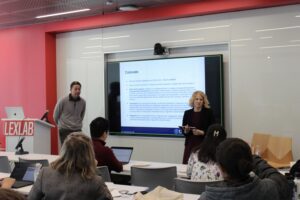
John Pavolotsky, a partner at Stoel Rives LLP who specializes in technology and AI-related legal matters, and Svetlana Matt ’12, director of public policy at Dish Network, examine Colorado’s landmark AI law and what it signals for future regulation during LexLab’s Law and AI Certificate program in March.
- LexLab’s weeklong Law and AI Certificate program explores how AI works, how it’s regulated, and how it’s reshaping legal practice.
- Lawyer participants learn from scholars, attorneys, and industry leaders from major companies, including Open AI, Anthropic, Microsoft, and Meta.
- The curriculum focuses on practical issues lawyers face in areas such as privacy, product liability, intellectual property, compliance, and risk management.
How does artificial intelligence actually work? How is it being regulated across the globe? What are the burning legal challenges and live disputes? And what does it mean for lawyers advising clients in an era of rapid technological change?

Participants in LexLab’s Law and AI Certificate program examine real-world applications of AI, learn from leading technologists, and leave equipped to address its legal and regulatory challenges.
Those questions — and more — are at the center of a weeklong, intensive program on AI and the law hosted by UC Law San Francisco’s LexLab, a center for technology law and lawyering.
LexLab held its second Law and Artificial Intelligence Certificate (LAIC) program from March 2 to 6, building on its inaugural session last summer. Just over two dozen people from across the country and around the world were selected to participate. Among them were lawyers, startup founders, nonprofit leaders, and academics. Some traveled from as far as Tokyo and Switzerland.
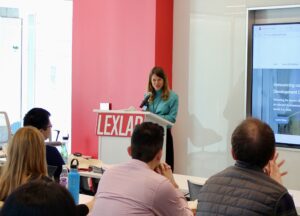
UC Law SF Director of Applied Innovation Tal Tal Niv conceived and helped design the program to meet a growing need among lawyers for clear, practical guidance on AI legal issues, risks, and real-world applications.
Over the course of the week, participants learned from 20 instructors working at the forefront of AI as regulators, founders, scholars, and practicing attorneys. Sessions covered the technological foundations of AI systems, along with governance, intellectual property, privacy, and risk in deploying AI tools. The program is designed to help lawyers understand the evolving legal, technological, and policy landscape surrounding AI and navigate its complex, often ambiguous implications across jurisdictions.
“The program provides both a technical grounding in how AI systems work and a practical understanding of how those systems are reshaping legal risk and opportunity,” said UC Law SF Director of Applied Innovation Tal Niv, who conceived the program.
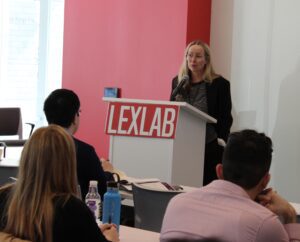
Adjunct Professor Cornelia Kutterer helped design the program and recruit leading voices from across industry, bringing her deep expertise in European AI regulation to shape its global perspective.
Niv is the Shashi and DJ Deb Professor of Practice for Emerging Technology and Law, an endowed professorship that advances UC Law SF’s leadership in AI, tech, and innovation-focused legal education.
Niv worked with Adjunct Professor Cornelia Kutterer, who previously led Microsoft’s Responsible Tech and Competition team in Europe, to design the course with a remarkable group of instructors, including counsel, entrepreneurs, and policymakers from companies such as Anthropic, OpenAI, Microsoft, Meta, and GitHub.
“What makes this program unique is the caliber and diversity of the instructors,” Kutterer said. “Participants are learning directly from people who are making real-time decisions about how AI is developed, deployed, and governed—and who are confronting these legal questions as they emerge.”
The program emerged from a plan to build new AI legal training programs not only for law students, but also for practicing lawyers navigating a fast-changing legal landscape, said LexLab Director Drew Amerson.
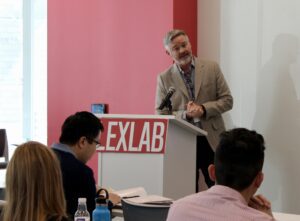
As director of LexLab, Drew Amerson supported launching new programs to equip law students and practicing lawyers with tools to navigate the evolving AI landscape.
“This program lets LexLab do what we do best: train lawyers and law students to think critically about technology, solve real-world problems, and lead in areas where law and innovation intersect,” Amerson said.
UC Law San Francisco faculty also played a key role, including Professor Robin Feldman, director of the Center for Innovation and its AI Law and Innovation Institute. In a keynote address, Feldman examined both the promise and risks of rapidly advancing AI technologies.
She highlighted how recent breakthroughs have enabled AI systems to perform complex tasks requiring judgment and reasoning — areas once thought to be uniquely human — while also raising urgent questions about regulation, accountability, and societal impact. Feldman pointed to concerns ranging from geopolitical competition and job displacement to intellectual property challenges, misinformation, and overreliance on AI-generated work.
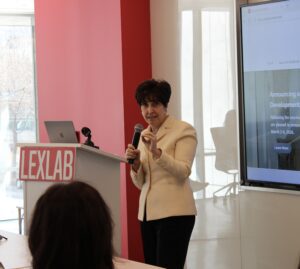
Professor Robin Feldman, director of UC Law SF’s Center for Innovation, delivered a keynote lecture examining both the promise and risks of rapidly advancing AI technologies
“The changes we’re seeing give us both opportunities and enormous challenges,” Feldman said. “Can we grab the reins and think about where we’re going and how we want to get there, or are we just going to be buffeted by the winds as these things unfold?”
Professor Paul Belonick, an expert in legal ethics and a scholar of ancient history and philosophy, explored the ethics of AI through the lens of Stoicism, a philosophy widely embraced in Silicon Valley but, Belonick notes, often in a form focused more on resilience and productivity than deeper ethical commitments. He urged participants to consider not just what AI can do, but what it should do.
“Are the goals and virtues of AI currently being suggested by Silicon Valley and its version of Stoicism truly the human goals we wish to pursue,” he asked.
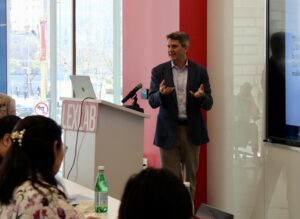
Professor Paul Belonick explored the ethics of AI through the lens of Stoicism, challenging participants to consider not just what AI can do, but what it should do.
Participants also examined how AI is being integrated into legal practice, from law firms and courts to corporate boardrooms, with sessions covering areas such as privacy, product liability, intellectual property, and global compliance.
Several attendees described how the program allowed them to build a deeper understanding of a rapidly evolving field.
Sammy Zeer, global indirect tax manager at Expedia Group, traveled from Seattle seeking a stronger foundation in responsible AI governance. He said the program “offered a grounded exploration of both the transformative potential and the real risks” of AI and provided “an exceptional foundation” for understanding its many implications.
Ben Whitlach ’20, director of customer success and legal specialist at Alumni, a venture capital portfolio management software company, said the program provides a clear understanding of the technology and its practical applications for lawyers.

Participants engage in discussions with fellow practicing attorneys, exchanging perspectives on the legal, ethical, and regulatory challenges posed by artificial intelligence.
“It helped demystify how modern AI systems work and how they are beginning to transform legal workflows,” Whitlach said. “What I found most valuable was the practical perspective on how lawyers can thoughtfully integrate AI into their daily work.”
The program also drew academics from outside the legal field. Jeff Huang, associate chair of the computer science department at Brown University, traveled across the country to gain insight into AI from a legal perspective.
“I appreciated hearing the many approaches, from legal practitioners, to the staffers who wrote some of the bills, to international policymakers,” Huang said.
By the end of the week, participants earned a certificate of completion along with more than 32 hours of continuing education credit required by the State Bar of California for licensed attorneys.
LexLab plans to hold its next Law and AI Certificate session at UC Law SF in July. The center is also in the advanced planning stages of offering the program in cities abroad, including Tokyo, through collaborations with international law schools.