Business Law Scholarship and Impact
Business Law Scholarship at UC Law San Francisco
UC Law SF faculty are leading voices on a range of business and contract law issues, including artificial intelligence, regulatory compliance and enforcement, venture capital, banking, securities, and autonomous systems.
Recent News | Selected Scholarship | Faculty
Recent News

Preparing Graduates for High-Impact Global Practice in Asia
UC Law SF graduates are forging legal careers in Japan and beyond—leading cross-border transactions, advising global clients, and bridging U.S.-Japan legal systems. Through specialized courses, study abroad-abroad opportunities, Japanese law curricula, and deep institutional partnerships, UC Law SF is preparing J.D. and LL.M. alumni for high-stakes international practice.
Read more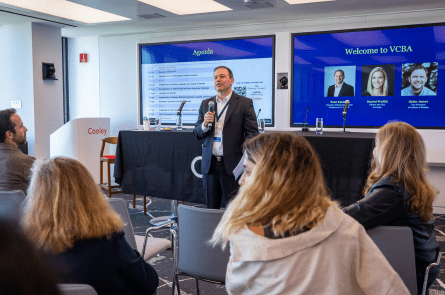
Preparing Directors for the Realities of Venture Governance
VCBA is a one-day executive education program tailored for board members of venture-backed private companies.
It tackles the governance challenges unique to startups—from fiduciary duties, executive compensation, and board composition to liquidity events, regulatory risks, and evolving VC funding dynamics. The program aims to give directors and senior executives practical tools and insight to govern effectively in today’s fast-changing venture environment.
Learn more about VCBA
Center for Business Law Scholars Gain Valuable Experience
The merit-based CBL Scholars Program offers financial support and mentorship to students from disadvantaged or nontraditional backgrounds, giving access to the Bay Area’s tech and VC ecosystems, and UC Law SF’s deep network of senior business law professionals.
The 2025 cohort includes rising leaders prepared to bring fresh perspectives into corporate and transactional law, helping ensure the business law field becomes more inclusive and connected to innovation.
Read more
New Faculty
Zac Henderson joins UC Law San Francisco as a visiting assistant professor and as senior researcher for the Center for Innovation. His research is centered around the nexus between the law and emerging technologies such as artificial intelligence, autonomous systems, and blockchain.
Tal Niv is our new director of applied innovation. She will contribute to the continued development of our tech law training program by teaching tech law classes, such as internet law, AI law, and international AI governance, helping to develop tech law curriculum through the tech law and lawyering concentration, and fostering a vibrant tech law community through LexLab activities.
They join Emily Strauss, associate professor of law, who joined the UC Law SF faculty last year from Duke Law School, where she was a lecturing fellow. She is an expert in securities regulation, banking, and business law. She is a former corporate lawyer, teacher, and Peace Corps volunteer.
At the Forefront of Innovation
The UC Law Center for Business Law San Francisco launched two startup-focused initiatives this year: the Startup Litigation Digest and the VC-Backed Board Academy (VCBA).
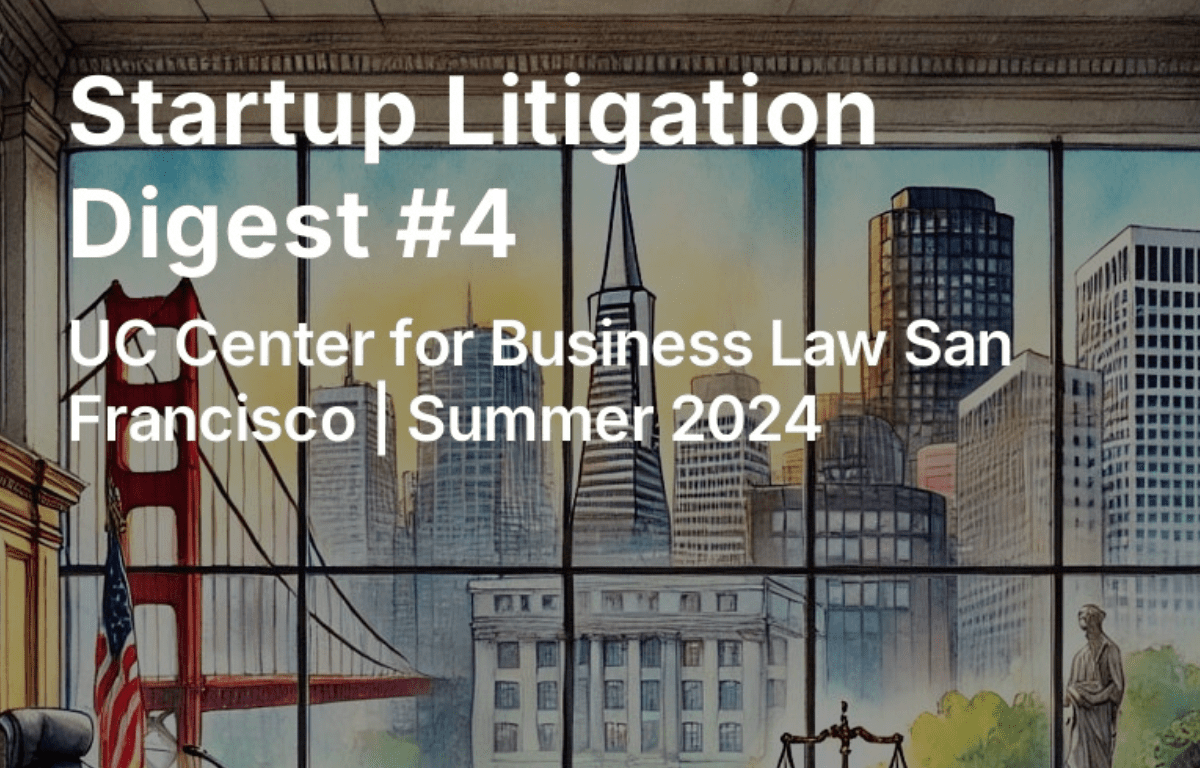
The Startup Litigation Digest, launched by Professors Evan Epstein and Abe Cable, sheds light on the world of private company litigation. Each edition of the publication highlights a new group of cases, including updates from prior editions. The content may involve shareholder litigation and/or enforcement actions from the SEC, DOJ and/or other enforcement agencies.
The VCBA is the center’s new executive education program for corporate directors and is addressing the unique challenges faced by directors of venture-backed companies. The inaugural program took place at Cooley’s SF offices with nearly 100 participants. The most recent VCBA program was held on October 2024, at Nasdaq’s MarketSite in New York City.

2024 SF Economic Outlook: AI & The Future of Corporate Governance
The UC Center for Business Law San Francisco presented the 7th Annual Regional Economic Outlook, co-hosted with the UCLA Anderson Forecast and the Bay Area Council Economic Institute. It addressed the latest economic outlook for the Bay Area, California, and U.S. including the prospect of economic growth, consumption, and investment growth.
A panel of experts discussed how AI integration is influencing business processes and the future of corporate governance.
Watch the Forecast video
Selected Scholarship and Highlights
Abe Cable, Psychic Income & Democratized Investing, Colorado Technology Law Journal.
Abe Cable, Stock Options of Adhesion. Journal of Corporation Law
Abe Cable, Why Charters? Washington University Law Review (online).
John Crawford, A Threshold Test for Fed Activism, William & Mary Business Law Review
John Crawford, The Double-Edged Sword of Dollar Sanctions, Case Western Law Review
Evan Epstein, What It Takes to Lead in the Boardroom: Insights for Prospective Directors, Harvard Law School Forum on Corporate Governance (with Jane Sadowsky and Kaley Karaffa).
Robin Feldman, AI versus IP: Rewriting Creativity (Cambridge University Press).
Robin Feldman, Dance of the Biologics, Berkeley Technology Law Journal (with Gideon Schor).
Robin Feldman, AI & Antitrust: The Algorithm Made Me Do It, Competition Journal, Antitrust Law Section (with Caroline Yuen).
Robin Feldman, The New Clinical Investigation exclusivity: a substantial source of monopoly time for brand drugs, Nature Biotechnology.
Robin Feldman, Pharmaceutical Mergers: Do We Have the Right Cure, Columbia Science and Technology Law Review.
Dave Owen, Allocating Electricity, George Washington Law Review.
Emily Strauss, Corporate Law and the End of Injunctions, Alabama Law Review.
Emily Strauss, Standing and Snitches, The Business Lawyer (Summer 2024)
Abe Cable’s article Regulating Democratized Investing, first published in Ohio State Law Journal, was selected for republication in the Securities Law Review. His Psychic Income & Democratized Investing, published in Colorado Technology Law Journal, explored the increasing difficulties in distinguishing investing from entertainment or other consumer experiences.
John Crawford published The Dollar Dilemma: Hegemony, Control, and the Dollar’s International Role in the Virginia Law & Business Review, which examined the risks created by the offshore U.S. dollar market, along with the tradeoffs involved in potential reforms to address those risks.
Evan Epstein was named one of the most influential leaders in corporate governance by the National Association of Corporate Directors (NACD) as part of the 2023 NACD Directorship 100™.
Jodi Short published Regulatory Managerialism as Gaslighting Government in Law & Contemporary Problems, which explored the uneven ways that management theory gets applied to government and businesses. She is co-author, with Jed Shugerman, of Major Questions about Presidentialism: Untangling the ‘Chain of Dependance’ Across Administrative Law, published in Boston College Law Review. Jodi has recently participated in conferences, colloquiums, and workshops relating to the policy and regulation of emerging technologies.
Emily Strauss’s article Is Everything Securities Fraud?, published in UC Irvine Law Review, appeared in The Top Ten List of Corporate and Securities Law Articles of 2023, and was selected for republication in the Securities Law Review. Her article Suing SPACs was selected for republication in the Corporate Practice Commentator.
Business Law Faculty

Abraham Cable
Professor of Law; Faculty Director of Online Education; Faculty Director, Center for Business Law, Harry & Lillian Hastings Research Chair
View Abraham Cable’s Profile


Tal Niv
Shashi & DJ Deb Endowed Professor of Practice for Emerging Technology and Law, Director of Applied Innovation, Faculty Co-Director of LexLab, and Technology Law and Lawyering Concentration Advisor
View Tal Niv’s Profile