Experts break down proposed California billionaire tax at UC Law SF
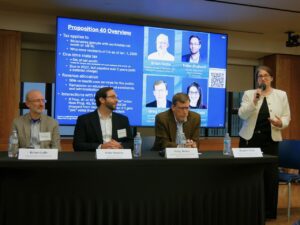
Tax law experts analyzed a proposed wealth tax on California billionaires at UC Law SF on Oct. 21. The panel included Brian Galle of UC Berkeley Law, Saba Shatara of Reed Smith and UC Davis Law, Greg Turner of the California Office of Tax Appeals and Heather Field of UC Law SF (left to right).
- Tax law experts discussed Prop. 40, a proposed 5% wealth tax on California billionaires, at UC Law SF.
- Panelists explained how the tax system treats wealth held in appreciating assets.
- The discussion covered potential constitutional challenges and California’s ability to administer the tax.
Tax law experts dug into the details of a proposed 5% wealth tax on California billionaires at UC Law San Francisco on Oct. 21. Voters will decide this November whether to approve the measure, Proposition 40.
Professor Heather Field, co-director of UC Law SF’s Center on Tax Law, led the discussion with panelists including Brian Galle, a UC Berkeley Law professor and one of Prop. 40’s drafters; Saba Shatara, a partner at Reed Smith and adjunct professor at UC Davis School of Law; and Greg Turner, an administrative law judge for the California Office of Tax Appeals and adjunct professor at UC Law SF, where he teaches state and local taxation.
The panel explored arguments for and against the tax, including proponents’ claim that it would help offset federal health care funding cuts to California under the One Big Beautiful Bill Act. The measure’s backers estimate it would raise about $100 billion over five years, with most of the revenue going to public health care.
Opponents argue the tax could drive billionaires out of California, weakening the state’s economy and reducing future tax revenue.
Field explained how billionaires can avoid paying taxes on rising wealth by holding assets and borrowing against them instead of selling.
“Those of you who have taken basic tax know that if you buy an asset and it increases in value, that increase is not treated as income under our federal income tax system until you have a disposition of the asset,” Field said.
Panelists discussed potential constitutional challenges, including whether the tax could violate protections against government taking private property, whether it could apply retroactively and whether California could tax wealth held outside the state. They also considered whether California has the resources and technical capacity to administer the new tax.
The event was sponsored by UC Law SF’s Center on Tax Law, UC Law SF Middle Eastern Law Society, UC Law SF Association of Tax Students, the Career Development Office and UC Law Associated Students.