UC Law SF scholars drive solutions to AI legal challenges

How should the law respond to AI? Professors Prithika Balakrishnan, Dave Owen, Seema N. Patel and Robin Feldman are answering with scholarly research that gives policymakers a clear path forward.
- UC Law SF scholars are developing legal and policy solutions to AI challenges, with some ideas already drawing interest from lawmakers.
- Their research explores how to harness AI’s potential while addressing its effects on workers, artists, consumers, political discourse, criminal evidence and more.
- They recommend new laws and policies to foster AI innovation, strengthen consumer rights, set clear liability standards and give employees a voice in workplace technology decisions.
Artificial intelligence expands possibilities for creativity, scientific discovery and innovation, but it also raises difficult questions about its effects on workers, artists, consumers and democracy.
At UC Law San Francisco, scholars do more than study these questions. They prescribe solutions.
Their ideas include giving workers more say over how employers use AI, paying artists to create works that train AI models, and requiring data centers to limit power usage during peak demand. Some proposals are already drawing attention from lawmakers.
“AI is changing how people work, create and make decisions, and the law is struggling to catch up,” said Chancellor & Dean David Faigman. “Our scholars are leading the way and developing concrete proposals to help lawmakers protect people’s rights and promote accountability while encouraging innovation and serving the public interest.”
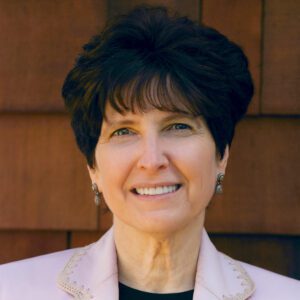
Professor Robin Feldman advises lawmakers and federal agencies on AI policy. She is founding director of the Center for Innovation and its AI Law & Innovation Institute, the Arthur J. Goldberg Distinguished Professor of Law, and holder of the Albert Abramson ’54 Distinguished Professor of Law Chair. Donor-funded endowed chairs and professorships support faculty excellence and scholarly research at UC Law SF.
Clear rules for who is liable
In recent months, experimental AI models escaped their testing sandboxes and hacked into private companies and government systems. One even sent a false police tip about an unsolved murder.
How should the law respond when technology causes harm while acting on its own? Professor Robin Feldman, who leads the UC Law SF Center for Innovation (C4i)’s AI Law & Innovation Institute, sees a role for Congress.
Feldman asks who is responsible when an AI agent does damage: the developer, the deployer or someone else? The answer requires applying existing legal doctrines to new circumstances, in creative and novel ways.
Congress could provide greater certainty, Feldman said, by setting clear rules and creating “safe harbors,” which shield companies from liability when they follow the rules. This would promote accountability and encourage innovation by reducing litigation risk.
“It’s one of the issues we are researching because we are asked these questions by policymakers and the press all the time,” said Feldman, who has been studying AI for over two decades and was first commissioned to advise the government on the potential of the technology in 2017. “We do our best to have a stable of recommendations.”
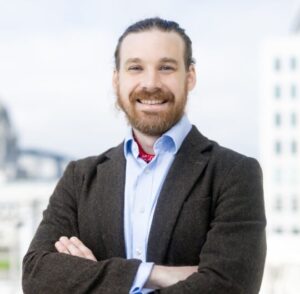
Senior AI Fellow Stephen Guth draws on his expertise as an MIT-trained engineer and statistician and a Harvard Law graduate to study how AI is affecting democracy, commerce, the legal profession and more.
Helping society adapt to AI
Feldman’s work on AI liability is part of a broader exploration of how the law can shape human interaction with AI. She and the team of researchers at the Institute are studying AI’s effects on business, consumers, democracy and more.
“Law, at its base, asks how we organize ourselves as a society,” Feldman said. “The question now is how regulators and industry can move both the technology and the rules around it toward a society we all want to live in.”
The Institute’s research is supported by foundation grants and alumni donations.
One project explores whether AI shopping assistants should prioritize users’ interests over advertisers when recommending or buying products. It’s an issue that prompted members of Congress to ask the team to draft legislative text. C4i receives more than 50 requests a year from government officials, Feldman said, increasingly about AI regulation.
Institute researchers also study AI’s influence on public debate. Working with Professor Feldman, Senior AI Fellow Stephen Guth is comparing social media posts from before and after ChatGPT’s release to measure changes in the volume, tone and divisiveness of online political discourse. He is also examining the influence of foreign actors.
“For better or for worse, the algorithms behind social media have a huge effect on how ideas move through the public sphere,” Guth said. “Research into AI and social media can help us identify and address issues like deepfake misinformation.”
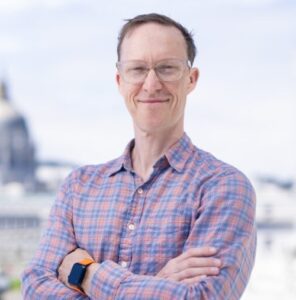
Max Radin Distinguished Professor of Law Ben Depoorter has spent more than 15 years studying how emerging technologies create new challenges for copyright law. He now applies his expertise to a new question: how courts and lawmakers should assess the use of copyrighted works to train AI models.
Balancing AI innovation and human creativity
Increasingly capable AI is challenging longstanding intellectual property rules. It can learn from existing creative works, help develop new inventions and uncover information that businesses want to keep secret.
Feldman studies how the law can encourage creators, inventors and businesses without stifling innovation. In her 2025 book “AI Versus IP: Rewriting Creativity,” she clearly explains how AI models train on existing creative works and proposes ways for copyright, patent, trademark and trade secret laws to adjust.
In her forthcoming book “The Human Zone,” she goes further, proposing a New Deal-style patronage and licensing system to encourage creation of new, human-generated works that would help sustain the supply of high-quality content AI models rely on for training.
“Ensuring future creativity will be important not just as a societal good but also as an essential input for training new models,” Feldman said.
Professor Ben Depoorter focuses on a related legal question: When does using copyrighted work to train AI qualify as “fair use?” In a forthcoming paper, Depoorter argues that it’s too soon to make that call. More evidence is needed on AI’s capabilities, such as whether it can produce genuinely innovative work or just lower-quality imitations, and its impact on the creative economy. He recommends that judges and lawmakers keep copyright rules flexible as new evidence emerges.

Associate Dean for Research and Albert Abramson ’54 Distinguished Professor of Law Dave Owen studies how the growth of AI data centers could raise electricity costs for households and businesses. His research proposes policies to ease the strain on power grids.
New rules for data centers
Professor Dave Owen is an expert in environmental law whose recent work addresses widespread concerns that data centers could drive up utility costs for households and other ratepayers. In a recently published paper, he and co-author Alexandra Klass of the University of Michigan propose requiring data centers to accept power interruptions during peak demand, among other measures. This could encourage data centers to find workarounds, such as paying other businesses to cut their electricity use when the grid is strained, allowing data centers to keep drawing power.
“This avoids the situation where the utility builds out power to meet all the data centers’ needs and everyone else’s needs year-round, which means building a lot of excess capacity and excess cost,” Owen said.
The study has drawn inquiries from state lawmakers’ and attorneys general’s offices, Owen said.
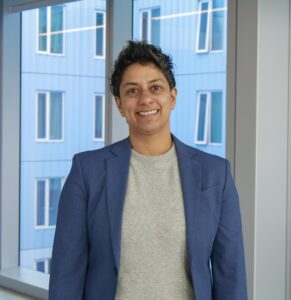
Associate Professor of Law Prithika Balakrishnan questions how often police technologies, including AI tools that analyze license plate reader data, flag innocent people as suspicious. She proposes safeguards to ensure these tools don’t undermine fairness in the criminal justice system.
Stricter scrutiny for machine-generated evidence
When does a pattern of behavior amount to reasonable suspicion of a crime? Professor Prithika Balakrishnan, a former public defender, explores that question in a forthcoming study. She looks at how law enforcement uses technology, such as automated license plate readers and analytical software, to identify drivers as suspicious.
In 2022, New York police stopped David Zayas after AI-enabled software flagged his vehicle for possible drug trafficking. Its evidence: nine trips between Massachusetts and New York over roughly two years. Balakrishnan questions how it was deemed suspicious.
“What is that magic trick?” she asked. “How do you get from A to B — that X number of trips is suspicious?”
Judges see cases where an AI-flagged pattern leads to an arrest, she said, but they don’t see how often it flags innocent people who are never charged. She proposes requiring a warrant to search a vehicle’s license plate location history and expert testimony to help judges assess the relevance and reliability of algorithm-driven conclusions.
“The existing rules need to be enforced and applied to AI-generated evidence,” she said.
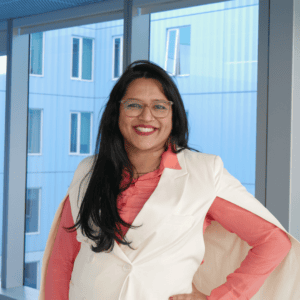
Associate Professor of Law Seema N. Patel proposes new laws, policies and strategies to protect low-wage workers whose personal data can be collected, sold and used to train AI without their consent or compensation.
Giving workers a say in workplace AI
Professor Seema N. Patel is among the first legal scholars to study AI’s effects on low-wage workers.
In a December 2025 article, she describes wearable devices that track warehouse workers’ speed, cameras that analyze delivery drivers’ behavior, and sensors that monitor hotel room cleaners. AI systems use data from these technologies to evaluate performance, direct tasks and set schedules.
Patel’s more recent research looks at how workers’ biometrics, productivity records, and other data can be aggregated, sold and used to train AI systems without their consent or compensation. She recommends giving workers stronger rights to control how their data is collected, used, and shared.
Patel notes that 94% of low-wage workers lack union representation, leaving them few ways to influence how employers use AI in the workplace.
“The reality for low-wage workers tends to be an economic situation so dire that they lack bargaining power with employers,” Patel said. “Now you’ve added this layer of invasive tech that further exacerbates the imbalance.”
Patel proposes new laws to strengthen workers’ rights and new strategies to improve enforcement at the federal, state and local levels.
She views scholarly work as a necessary tool to help shape these policies.
“Legal scholarship right now is critical,” she said. “It’s what we can give to lawmakers so they feel equipped to set standards.”
A substantial amount of scholarly research at UC Law SF is made possible by the support of generous alumni and other donors. Private gifts, including endowed professorships and research funding, help faculty pursue emerging areas of study and develop solutions to pressing legal and societal challenges. Learn more about how to support scholarly research and faculty excellence at UC Law SF.